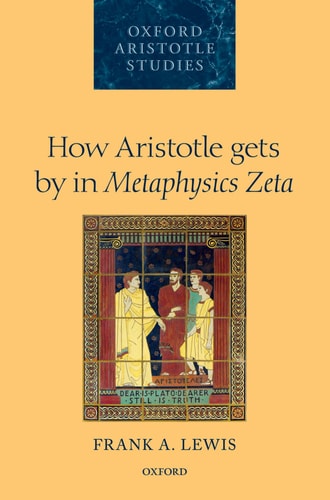
How Aristotle Gets By In Metaphysics Zeta
0
0
As an Amazon Associate and affiliate partner, Menrva Books earns from qualifying purchases. Learn more
Author Description
Frank A. Lewis presents a closely argued exposition of Metaphysics Zeta--one of Aristotle's most dense and controversial texts. It is commonly understood to contain Aristotle's deepest thoughts on the definition of substance and surrounding metaphysical issues. But people have increasingly come to recognize how little Aristotle says in Zeta about his own theory of (Aristotelian) form and matter. Instead, he spends the bulk of the book examining 'received opinions', often as filtered through his own Organon, but including above all the views of Plato, who is at times friend, and at times foe. For much of the time, we are left to reconstruct Aristotle's finished views, subject to the constraint that they survive the critique he directs in Zeta at the philosophical tradition.In this book, Lewis argues that in giving his actual conclusion to Zeta in its final chapter, 17, Aristotle drops his earlier, largely critical engagement with received views, and turns approvingly to his own Posterior Analytics. The result is a causal view of (primary) substance, representing the property of being a (primary) substance (or the substance of a thing) as, in modern dress, the second-order functional property of (Aristotelian) forms, that they be the cause of being for different compound material substances. The property of being the cause of being for a thing is a role property, and it is realized in different forms and the sets of causal powers associated with them, matching the variety of things that have a form as their substance.Meanwhile, the failure of previous attempts at definition in earlier chapters leaves Aristotle's own definition standing as the 'best explanation' for the views proprietary to the theory of form and matter. The point that (Aristotelian) forms are the primary substances is not the main conclusion to Zeta, but rather a result his definition must give, if the definition is to be acceptable.
Menrva's Summary
THE THESIS
This book investigates the core question of how Aristotle defines substance within the complex and often elusive framework of Metaphysics Zeta. Frank A. Lewis, a scholar of ancient philosophy, provides a rigorous examination of the text, arguing that Aristotle shifts from a critical engagement with historical predecessors to a constructive, causal theory of substance in the final chapter. By analyzing the relationship between form, matter, and causality, Lewis posits that Aristotle’s ultimate definition of substance functions as a second-order property, serving as the cause of being for compound material entities.
THE SCOPE MAP
What You Will Find
- A detailed analysis of Metaphysics Zeta, focusing on the definition of substance and the role of form and matter.
- A comparative study of Aristotle’s engagement with Platonic thought and the philosophical tradition.
- A methodological framework linking the arguments in Zeta to the principles established in the Posterior Analytics.
- An interpretation of Aristotelian forms as functional, causal properties that define the essence of compound substances.
THE AUTHORITY PERSPECTIVE
Scholars and students of Aristotelian philosophy frequently cite this work for its meticulous reconstruction of the philosopher's often fragmented arguments. Experts highlight the text as a significant contribution to the understanding of Metaphysics Zeta, noting the density of the prose and the precision of Lewis's analytical approach.
Page Count:
336
Publication Date:
2013-08-24
Publisher:
Oxford University Press
ISBN-10:
0199664013
ISBN-13:
9780199664016
Philosophy
Aristotle
Metaphysics
Community Tags
Other Editions(3)

Similar Books
Reader Comments
Share Your Thoughts
No comments yet. Be the first to share your thoughts!