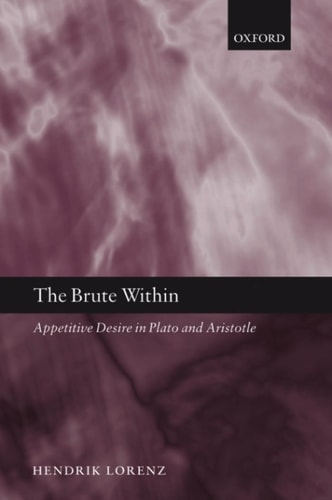
The Brute Within: Appetitive Desire in Plato and Aristotle
0
0
As an Amazon Associate and affiliate partner, Menrva Books earns from qualifying purchases. Learn more
Author Description
Hendrik Lorenz presents a comprehensive study of Plato's and Aristotle's conceptions of non-rational desire. They see this as something that humans share with animals, and which aims primarily at the pleasures of food, drink, and sex. Lorenz explores the cognitive resources that both philosophers make available for the explanation of such desires, and what they take rationality to add to the motivational structure of human beings. In doing so, he exposes a remarkable degree of continuity between Plato's and Aristotle's thought in this area. He also sheds fresh light, not only on both philosophers' theories of motivation, but also on how they conceive of the mind, both in itself and in relation to the body.
Menrva's Summary
THE THESIS
This work investigates the conceptualization of non-rational, appetitive desire within the philosophical frameworks of Plato and Aristotle. Hendrik Lorenz, a scholar of ancient philosophy, examines how these thinkers define the motivational structures shared by humans and animals. By analyzing the cognitive resources attributed to these desires, the author argues for a significant continuity between the two philosophers regarding the interaction between rationality, the mind, and the body.
THE SCOPE MAP
What You Will Find
- Comparative analysis of Platonic and Aristotelian theories of motivation
- Examination of appetitive desires related to food, drink, and sex
- Investigation into the relationship between the mind and the body
- Discussion of the role of rationality in human motivational structures
Scope Limits
- Does not provide a general history of ancient Greek ethics
- Focuses primarily on non-rational desire rather than the entirety of their psychological theories
THE AUTHORITY PERSPECTIVE
Scholars and students of classical philosophy frequently cite this text for its rigorous analysis of the psychological underpinnings in Plato and Aristotle. Experts highlight the work as a specialized, dense contribution that clarifies the intersection of animalistic drives and human reason in ancient thought.
Page Count:
240
Publication Date:
2006-01-01
Publisher:
Clarendon Press
ISBN-10:
0191537403
ISBN-13:
9780191537400
Philosophy
History & Surveys
Aristotle
Metaphysics
Ethics
Plato
Community Tags
Similar Books