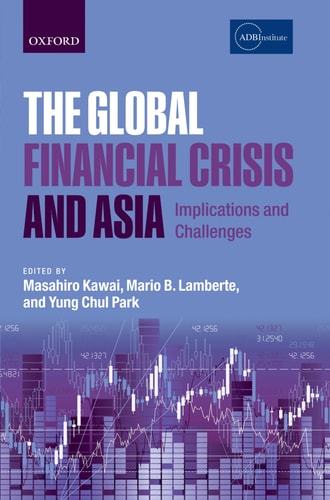
The Global Financial Crisis and Asia: Implications and Challenges
0
0
As an Amazon Associate and affiliate partner, Menrva Books earns from qualifying purchases. Learn more
Author Description
This book aims to identify and analyze the impact of the 2007-09 global financial crisis on Asian economies and to assess the short-term and longer-term policy responses to the crisis in terms of their effectiveness and sustainability. It draws lessons on how best to avoid and/or mitigate future crises and to identify structural policy recommendations that can help guide Asian policymakers to expand the growth potential of domestic and regional demand in coming years, and thereby create a basis for sustainable and inclusive long-term growth.Organized into four parts, it offers an accessible explanation of the causes, consequences, and contagion mechanisms of the crisis. Part 1 provides an overview of the major issues and presents policy recommendations. Part 2 reviews the crisis in the US and its transmission to Europe. Part 3 focuses on the impact on Asia. And Part 4 concludes lessons of the crisis for Asian countries. The volume highlights that Asian economies have already recovered strongly from the global financial crisis, reflecting their aggressive moves to ease monetary and fiscal policy as well as the underlying fundamental strength of their economies. However, the biggest challenge lies ahead. It asserts that, given that it is unlikely that the US and Europe will be engines of global growth, Asian economies should contribute to global economic adjustment by creating their own growth engines.
Menrva's Summary
THE THESIS
This book investigates the transmission mechanisms of the 2007-2009 global financial crisis to Asian economies and evaluates the efficacy of subsequent policy responses. The authors, Mario B. Lamberte, Masahiro Kawai, and Yung Chul Park, utilize a comparative analytical framework to examine how regional economies navigated the downturn. By synthesizing macroeconomic data and policy outcomes, the text argues that Asian nations must transition toward domestic and regional demand-led growth to ensure long-term sustainability in a post-crisis global landscape.
THE SCOPE MAP
What You Will Find
- Analysis of the contagion mechanisms that transmitted the US and European financial crisis to Asian markets.
- Evaluation of monetary and fiscal policy interventions implemented by Asian governments.
- Comparative assessment of pre-crisis economic fundamentals versus post-crisis recovery trajectories.
- Structural policy recommendations for fostering regional growth engines independent of Western demand.
THE AUTHORITY PERSPECTIVE
Experts recognize this volume as a comprehensive resource for understanding the regional economic shifts following the 2008 collapse. Readers frequently note the academic density of the prose, which serves as a foundational text for students and policymakers interested in Asian economic resilience.
Page Count:
344
Publication Date:
2012-12-29
Publisher:
Oxford University Press
ISBN-10:
0199660956
ISBN-13:
9780199660957
Economics
Finance
International relations
Public Policy
Asia
Community Tags
Similar Books