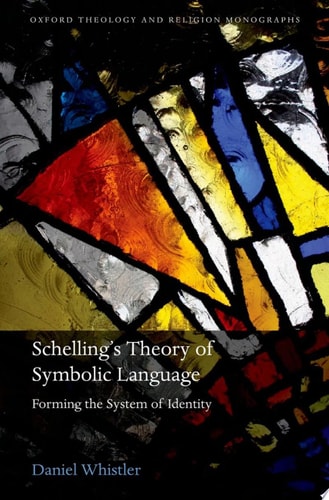
Schelling's Theory of Symbolic Language: Forming the System of Identity
0
0
As an Amazon Associate and affiliate partner, Menrva Books earns from qualifying purchases. Learn more
Author Description
This study reconstructs F.W.J. Schelling's philosophy of language based on a detailed reading of SC73 of Schelling's lectures on the Philosophy of Art. Daniel Whistler argues that the concept of the symbol present in this lecture course, and elsewhere in Schelling's writings of the period, provides the key for a non-referential conception of language, where what matters is the intensity at which identity is produced. Such a reconstruction leads Whistler to a detailed analysis of Schelling's system of identity, his grand project of the years 1801 to 1805, which has been continually neglected by contemporary scholarship. In particular, Whistler recovers the concepts of quantitative differentiation and construction as central to Schelling's project of the period. This reconstruction also leads to an original reading of the origins of the concept of the symbol in German thought: there is not one "romantic symbol", but a whole plethora of experiments in theorising symbolism taking place at the turn of the nineteenth century. At stake, then, is Schelling as a philosopher of language, Schelling as a systematiser of identity, and Schelling as a theorist of the symbol.
Menrva's Summary
THE THESIS
This study investigates the neglected role of symbolic language within F.W.J. Schelling's system of identity, arguing that his theory of the symbol provides a non-referential framework for understanding linguistic production. Daniel Whistler, a scholar of German Idealism, utilizes a rigorous examination of Schelling's 1801-1805 lecture series and writings to reconstruct the philosopher's systematic project. By focusing on the concept of the symbol as a mechanism for producing identity, Whistler challenges traditional interpretations of Schelling's work. The text posits that Schelling's philosophy of language is central to his broader metaphysical system, rather than a peripheral concern.
THE SCOPE MAP
What You Will Find
- A detailed analysis of SC73 from Schelling's lectures on the Philosophy of Art.
- An examination of the concepts of quantitative differentiation and construction within the system of identity.
- A historical survey of the diverse theories of symbolism prevalent in German thought at the turn of the nineteenth century.
- A methodological framework for interpreting language as a non-referential, intensive process.
THE AUTHORITY PERSPECTIVE
Scholars recognize this monograph as a significant contribution to the study of German Idealism, particularly for its recovery of Schelling's neglected middle-period writings. Readers frequently note the academic density of the prose, which requires a strong background in continental philosophy to fully navigate the author's complex arguments.
Page Count:
276
Publication Date:
2013-05-19
Publisher:
Oxford University Press
ISBN-10:
019967373X
ISBN-13:
9780199673735
Philosophy
Linguistics
Identity Philosophical concept
Theology
Community Tags
Similar Books