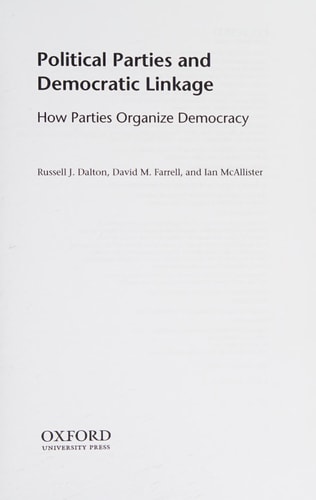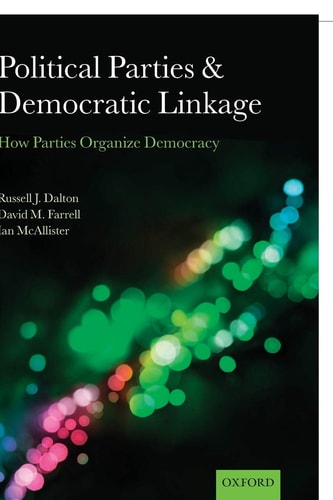
Political Parties and Democratic Linkage: How Parties Organize Democracy
0
0
As an Amazon Associate and affiliate partner, Menrva Books earns from qualifying purchases. Learn more
Author Description
Is the party over? Parties are the central institutions of representative democracy, but critics increasingly claim that parties are failing to perform their democratic functions. This book assembles unprecedented cross-national evidence to assess how parties link the individual citizen to the formation of governments and then to government policies. Using the Comparative Study of Electoral Systems and other recent cross-national data, the authors examine the workings of this party linkage process across established and new democracies. Political parties still dominate the electoral process in shaping the discourse of campaigns, the selection of candidates, and mobilizing citizens to vote. Equally striking, parties link citizen preferences to the choice of representatives, with strong congruence between voter and party Left/Right positions. These preferences are then translated in the formation of coalition governments and their policies.The authors argue that the critics of parties have overlooked the ability of political parties to adapt to changing conditions in order to perform their crucial linkage functions. As the context of politics and societies have changed, so too have political parties. Political Parties and Democratic Linkage argues that the process of party government is alive and well in most contemporary democracies.
Menrva's Summary
THE THESIS
This book investigates whether political parties remain effective institutions for linking individual citizens to government policy and democratic representation in contemporary societies. The authors, David M. Farrell, Ian McAllister, and Russell J. Dalton, utilize extensive cross-national data from the Comparative Study of Electoral Systems to challenge the prevailing narrative that political parties are in terminal decline. They argue that while the environment of modern politics has shifted, parties have demonstrated significant adaptive capacity to maintain their role as the primary conduits between voter preferences and legislative outcomes.
THE SCOPE MAP
What You Will Find
- Comparative analysis of party functions across both established and emerging democratic systems.
- Empirical assessment of the congruence between voter ideology and party positioning on the Left/Right spectrum.
- Examination of the role of parties in candidate selection, campaign discourse, and voter mobilization.
- Evaluation of the translation process from electoral results to coalition government formation and policy implementation.
THE AUTHORITY PERSPECTIVE
Experts recognize this work as a significant empirical contribution to the study of representative democracy and institutional adaptation. Readers frequently note the academic density of the prose, which relies heavily on statistical data to support its central arguments regarding the resilience of party systems.
Page Count:
256
Publication Date:
2013-08-16
Publisher:
Oxford University Press
ISBN-10:
0199674965
ISBN-13:
9780199674961
Elections
Representative government and representation
Government
Democracy