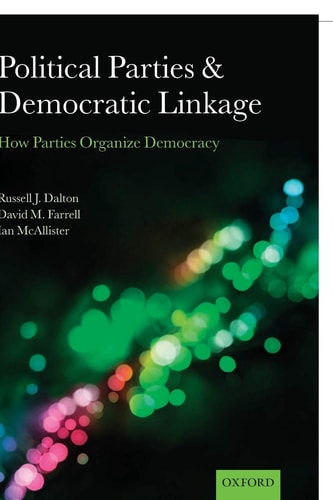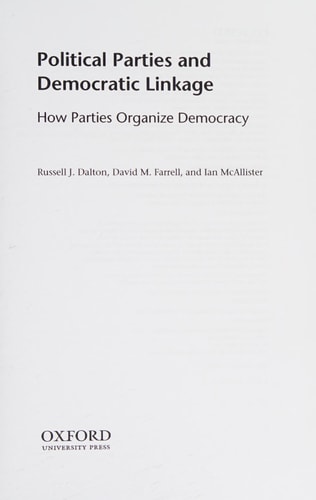
Political Parties and Democratic Linkage: How Parties Organize Democracy
0
0
As an Amazon Associate and affiliate partner, Menrva Books earns from qualifying purchases. Learn more
Author Description
Is the party over? Parties are the central institutions of representative democracy, but critics increasingly claim that parties are failing to perform their democratic functions. Political Parties and Democratic Linkage assembles unprecedented cross-national evidence to assess how parties link the individual citizen to the formation of governments and then to government policies. Using the Comparative Study of Electoral Systems and other recent cross-national data, the authors examine the workings of this party linkage process across established and new democracies. Political parties still dominate the electoral process in shaping the discourse of campaigns, the selection of candidates, and mobilizing citizens to vote. Equally striking, parties link citizen preferences to the choice of representatives, with strong congruence between voter and party Left/Right positions. These preferences are then translated in the formation of coalition governments and their policies.The authors argue that the critics of parties have overlooked the ability of political parties to adapt to changing conditions in order to perform their crucial linkage functions. As the context of politics and societies have changed, so too have political parties. Political Parties and Democratic Linkage argues that the process of party government is alive and well in most contemporary democracies.
Menrva's Summary
THE THESIS
This book investigates whether political parties remain effective institutions for linking individual citizens to government policy and representation in contemporary democracies. The authors, David M. Farrell, Ian McAllister, and Russell J. Dalton, utilize extensive cross-national data from the Comparative Study of Electoral Systems to challenge the prevailing narrative that political parties are in terminal decline. By analyzing the mechanisms of candidate selection, campaign discourse, and coalition formation, they argue that parties have successfully adapted to shifting societal conditions to maintain their role as the primary conduits of democratic governance.
THE SCOPE MAP
What You Will Find
- Comparative analysis of party linkage processes across both established and emerging democratic systems.
- Empirical examination of the congruence between voter preferences and party ideological positioning on the Left/Right spectrum.
- Quantitative data sets derived from the Comparative Study of Electoral Systems and other international political surveys.
- Evaluation of how parties manage candidate selection, voter mobilization, and the translation of electoral outcomes into government policy.
THE AUTHORITY PERSPECTIVE
Experts recognize this work as a significant contribution to the study of representative institutions, noting its reliance on robust empirical evidence to counter pessimistic views on party viability. Readers frequently highlight the clarity of the authors' arguments regarding the adaptive capacity of modern political organizations.
Page Count:
272
Publication Date:
2011-12-15
Publisher:
Oxford University Press
ISBN-10:
0199599351
ISBN-13:
9780199599356
Government
Electoral Systems
Democracy
Comparative Politics