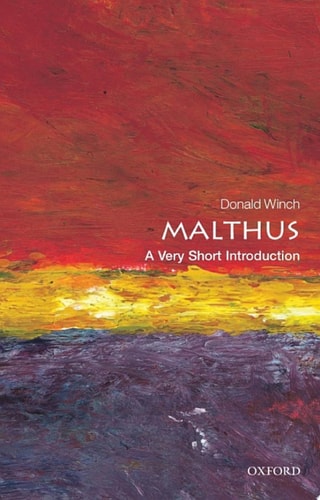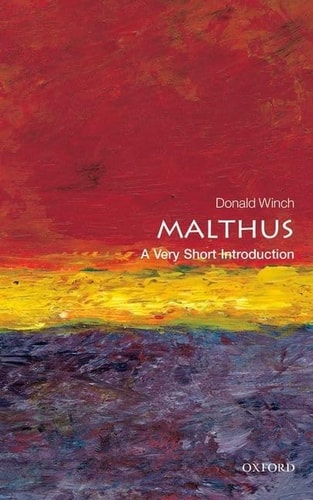
Malthus: A Very Short Introduction
0
0
As an Amazon Associate and affiliate partner, Menrva Books earns from qualifying purchases. Learn more
Author Description
With world population today edging over seven billion, and with projections for it to reach nine billion by mid-century, the ideas of eighteenth-century English cleric Thomas Malthus-and his grim prediction that war, plague, and famine are the inevitable response to overpopulation--loom ever larger on the horizon. But if Malthus is a familiar name to most educated people, few of us have read his famous and controversial work, Essay on the Principle of Population, and indeed few have but a sketchy notion of his ideas. In this Very Short Introduction, Donald Winch explains and clarifies Malthus's thought, assessing the profound influence he has had on modern economics. Concentrating on his writings, Winch sheds light on the context in which he wrote and why his work has remained controversial. Looking at Malthus's early life as well as the evolution of his theories from population to political economy, Winch considers why and how Malthus's writings have been so influential in the thought of later figures such as Charles Darwin and John Maynard Keynes.
Menrva's Summary
THE THESIS
This book investigates the enduring relevance of Thomas Malthus’s theories on population growth and their foundational impact on modern economic thought. Donald Winch, a distinguished scholar of intellectual history, utilizes Malthus’s primary texts to reconstruct the historical context of his arguments. By examining the evolution of Malthusian thought from early demographic concerns to broader political economy, Winch provides a rigorous framework for understanding why these ideas remain central to contemporary debates on resources and sustainability.
THE SCOPE MAP
What You Will Find
- An analysis of the Essay on the Principle of Population and its subsequent revisions.
- Historical context regarding eighteenth-century English social and economic conditions.
- An exploration of Malthus’s intellectual influence on figures such as Charles Darwin and John Maynard Keynes.
- A critical assessment of the transition from demographic theory to political economy.
THE AUTHORITY PERSPECTIVE
Experts recognize this volume as a precise and accessible entry point for students and general readers interested in the history of economic thought. The text is frequently praised for its ability to distill complex intellectual history into a concise, balanced narrative without sacrificing academic rigor.
Page Count:
152
Publication Date:
2013-01-01
Publisher:
Oxford University Press
ISBN-10:
0199670412
ISBN-13:
9780199670413
History
Biography
Philosophy
Economics
Sociology