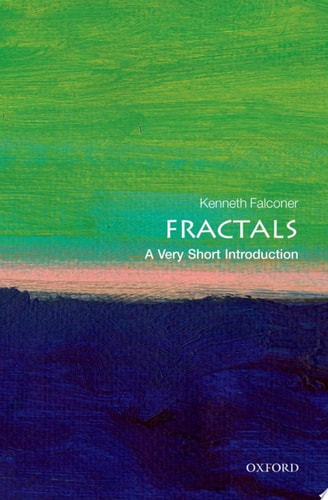
Fractals: A Very Short Introduction
0
0
As an Amazon Associate and affiliate partner, Menrva Books earns from qualifying purchases. Learn more
Author Description
From the contours of coastlines to the outlines of clouds, and the branching of trees, fractal shapes can be found everywhere in nature. In this Very Short Introduction, Kenneth Falconer explains the basic concepts of fractal geometry, which produced a revolution in our mathematical understanding of patterns in the twentieth century, and explores the wide range of applications in science, and in aspects of economics.About the Series:Oxford's Very Short Introductions series offers concise and original introductions to a wide range of subjects--from Islam to Sociology, Politics to Classics, Literary Theory to History, and Archaeology to the Bible. Not simply a textbook of definitions, each volume in this series provides trenchant and provocative--yet always balanced and complete--discussions of the central issues in a given discipline or field. Every Very Short Introduction gives a readable evolution of the subject in question, demonstrating how the subject has developed and how it has influenced society. Eventually, the series will encompass every major academic discipline, offering all students an accessible and abundant reference library. Whatever the area of study that one deems important or appealing, whatever the topic that fascinates the general reader, the Very Short Introductions series has a handy and affordable guide that will likely prove indispensable.
Menrva's Summary
THE THESIS
This book investigates the mathematical principles of fractal geometry and their pervasive presence in both natural phenomena and complex systems. Kenneth Falconer, a professor of pure mathematics, utilizes his expertise to distill the history and application of fractal theory into an accessible format. He argues that fractals represent a fundamental shift in how scientists model irregular patterns, moving beyond traditional Euclidean geometry to describe the complexity of the physical world.
THE SCOPE MAP
What You Will Find
- An overview of the historical development of fractal geometry in the twentieth century.
- Explanations of core concepts such as self-similarity, dimension, and scaling.
- Applications of fractal analysis in fields ranging from biology and meteorology to economics.
- Analysis of how fractal shapes appear in natural structures like coastlines, clouds, and tree branches.
THE AUTHORITY PERSPECTIVE
Experts recognize this volume as a concise and reliable entry point for those seeking to understand the mathematical foundations of fractal patterns. Readers frequently note that while the text is brief, it maintains a high level of academic rigor suitable for students and curious laypeople alike.
Page Count:
152
Publication Date:
2013-12-01
Publisher:
Oxford University Press
ISBN-10:
0199675988
ISBN-13:
9780199675982
Science
Nature
Non-Fiction
Geometry
Fractals
Mathematics Statistics
Mathematics - General
Mathematics