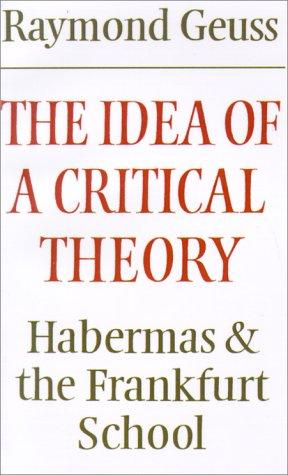
The Idea of a Critical Theory
0
0
As an Amazon Associate and affiliate partner, Menrva Books earns from qualifying purchases. Learn more
Author Description
Habermas and earlier members of the Frankfurt School have presented critical theory as a radically new form of knowledge. It is differentiated from the natural sciences as essentially 'reflective': the knowledge it provides guides us towards enlightenment as to our true interests, and emancipation from often unsuspected forms of external and internal coercion. Its first paradigms are in the writings of Marx and Freud. In this book Raymond Geuss sets out these fundamental claims and asks whether they can be made good. Is a science which does not simply describe and explain social phenomena, but also criticizes? The concept of ideology plays a crucial role in this discussion. Geuss carefully analyses it here, its relation to our beliefs and interests, and the account of truth and confirmation required by its critique and the concomitant goal of self-knowledge. The book does not presuppose acquaintance with the works of the Frankfurt School and can serve as a lucid introduction to their central, distinctive theses. But in its scrupulous and incisive consideration of these, and the modified support for them that emerges, it will also interest experts on critical theory and others concerned with the methods and purposes of the social sciences in general.
Menrva's Summary
THE THESIS
This book investigates whether critical theory, as presented by the Frankfurt School, can truly be a distinct form of knowledge that guides individuals toward enlightenment and emancipation. Raymond Geuss examines the core claims of critical theory, particularly its reflective nature and its differentiation from the natural sciences. He scrutinizes the role of ideology, its connection to beliefs and interests, and the concepts of truth and confirmation necessary for self-knowledge and critique. The book aims to provide an accessible introduction to these central theses while also engaging experts with its detailed analysis.
THE SCOPE MAP
- Analysis of the Frankfurt School's concept of critical theory as a unique form of knowledge.
- Examination of the reflective nature of critical theory and its goal of emancipation.
- Detailed discussion of the concept of ideology and its relation to beliefs and interests.
- Exploration of truth, confirmation, and self-knowledge within critical theory.
- Scrutiny of the fundamental claims of critical theory, particularly those of Marx and Freud.
- Consideration of whether a science that criticizes social phenomena is possible.
THE AUTHORITY PERSPECTIVE
The book is presented as a lucid introduction to the central theses of the Frankfurt School, suitable for those unfamiliar with their work. Its scrupulous and incisive consideration of these ideas, leading to a modified support for them, is also noted as a point of interest for experts in critical theory and those concerned with the broader methods and purposes of the social sciences. The analysis of ideology and its implications for self-knowledge is a key focus.
Page Count:
100
Publication Date:
1981-01-01
ISBN-10:
0521240727
Philosophy
Non-Fiction
Critical Theory
Community Tags
Similar Books