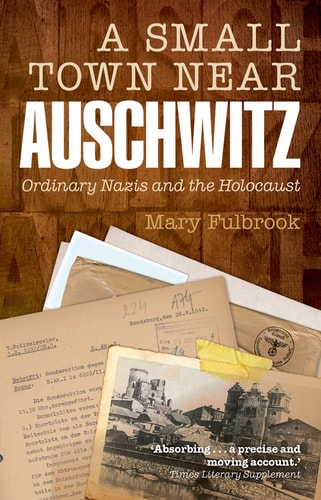
A Small Town Near Auschwitz: Ordinary Nazis and the Holocaust
0
0
As an Amazon Associate and affiliate partner, Menrva Books earns from qualifying purchases. Learn more
Author Description
The Silesian town of Bedzin lies a mere twenty-five miles from Auschwitz; through the linked ghettos of Bedzin and its neighbouring town, some 85,000 Jews passed on their way to slave labour or the gas chambers.The principal civilian administrator of Bedzin, Udo Klausa, was a happily married family man. He was also responsible for implementing Nazi policies towards the Jews in his area - inhumane processes that were the precursors of genocide. Yet he later claimed, like so many other Germans after the war, that he had 'known nothing about it'; and that he had personally tried to save a Jew before he himself managed to leave for military service. A Small Town Near Auschwitz re-creates Udo Klausa's story. Using a wealth of personal letters, memoirs, testimonies, interviews and other sources, Mary Fulbrook pieces together his role in the unfolding stigmatization and degradation of the Jews under his authoritiy, as well as the heroic attempts at resistance on the part of some of his victims. She also gives us a fascinating insight into the inner conflicts of a Nazi functionary who, throughout, considered himself a 'decent' man. And she explores the conflicting memories and evasions of his life after the war.But the book is much more than a portrayal of an individual man. Udo Klausa's case is so important because it is in many ways so typical. Behind Klausa's story is the larger story of how countless local functionaries across the Third Reich facilitated the murderous plans of a relatively small number among the Nazi elite - and of how those plans could never have been realized, on the same scale, without the diligent cooperation of these generally very ordinary administrators. As Fulbrook shows, men like Klausa 'knew' and yet mostly suppressed this knowledge, performing their day jobs without apparent recognition of their own role in the system, or any sense of personal wrongdoing or remorse - either before or after 1945.
Menrva's Summary
THE THESIS
This work investigates how ordinary local administrators in the Third Reich facilitated the Holocaust while maintaining a self-perception of personal decency. Mary Fulbrook, a professor of German history, utilizes the case study of Udo Klausa, a civilian administrator in Bedzin, to examine the psychological and bureaucratic mechanisms that allowed individuals to participate in systemic genocide. By analyzing personal correspondence, memoirs, and postwar testimonies, the author argues that the Holocaust relied heavily on the diligent, often mundane cooperation of local functionaries who suppressed the reality of their actions.
THE SCOPE MAP
What You Will Find
- Detailed examination of the administrative role of Udo Klausa in the Bedzin and Sosnowiec ghettos.
- Analysis of the psychological dissonance and postwar rationalizations of Nazi functionaries.
- Integration of primary source materials including personal letters, official records, and survivor testimonies.
- Exploration of the broader structural cooperation required to implement Nazi racial policies at the local level.
THE AUTHORITY PERSPECTIVE
Historians and scholars of the Third Reich recognize this text as a significant contribution to the study of perpetrator psychology and the mechanics of the Holocaust. Readers frequently note the academic rigor and the unsettling clarity with which the author exposes the banality of evil within local administrative structures.
Page Count:
440
Publication Date:
2013-09-15
Publisher:
Oxford University Press, Usa
ISBN-10:
0199679258
ISBN-13:
9780199679256
History
Biography
Jews poland
Poland
Jewish History
Holocaust
Germany
Poland biography
Historians germany
Jews
Community Tags
Similar Books