The Voices of the Holocaust: The 1946 Holocaust Interviews of David Boder
0
0
As an Amazon Associate and affiliate partner, Menrva Books earns from qualifying purchases. Learn more
Author Description
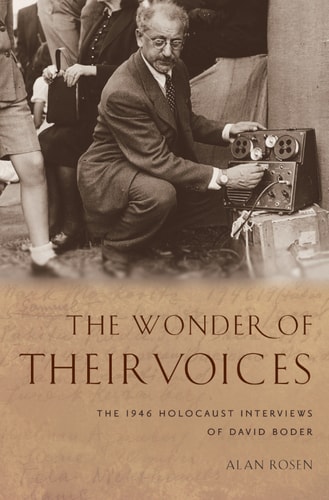
Over the last several decades, video testimony with aging Holocaust survivors has brought these witnesses into the limelight. Yet the success of these projects has made it seem that little survivor testimony took place in earlier years. In truth, thousands of survivors began to recount their experience at the earliest opportunity. This book provides the first full-length case study of early postwar Holocaust testimony, focusing on David Boder's 1946 displaced persons interview project. In July 1946, Boder, a psychologist, traveled to Europe to interview victims of the Holocaust who were in the Displaced Persons (DP) camps and what he called "shelter houses." During his nine weeks in Europe, Boder carried out approximately 130 interviews in nine languages and recorded them on a wire recorder. Likely the earliest audio recorded testimony of Holocaust survivors, the interviews are valuable today for the spoken word (that of the DP narrators and of Boder himself) and also for the song sessions and religious services that Boder recorded. Eighty sessions were eventually transcribed into English, most of which were included in a self-published manuscript. Alan Rosen sets Boder's project in the context of the postwar response to displaced persons, sketches the dramatic background of his previous life and work, chronicles in detail the evolving process of interviewing both Jewish and non-Jewish DPs, and examines from several angles the implications for the history of Holocaust testimony.Such early postwar testimony, Rosen avers, deserves to be taken on its own terms rather than to be enfolded into earlier or later schemas of testimony. Moreover, Boder's efforts and the support he was given for them demonstrate that American postwar response to the Holocaust was not universally indifferent but rather often engaged, concerned, and resourceful.
Menrva's Summary
THE THESIS
This book investigates the historical significance and methodological origins of the earliest audio-recorded Holocaust survivor testimonies conducted by psychologist David Boder in 1946. Alan Rosen, an expert in Holocaust literature and testimony, utilizes Boder's original wire recordings and transcripts to challenge the assumption that survivor accounts only emerged decades after the war. By contextualizing Boder's 130 interviews within the immediate postwar landscape of Displaced Persons camps, Rosen argues that early American engagement with Holocaust survivors was far more active and resourceful than traditional historical narratives suggest.
THE SCOPE MAP
What You Will Find
- A detailed examination of David Boder's 1946 European interview project involving 130 displaced persons.
- Analysis of the technical and ethical challenges of using wire recording technology in immediate postwar conditions.
- Primary source evidence derived from Boder's original transcripts, song sessions, and religious recordings.
- A historical framework for understanding early postwar responses to the Holocaust outside of later established schemas.
THE AUTHORITY PERSPECTIVE
Scholars and historians recognize this work as a foundational study for understanding the evolution of Holocaust documentation and oral history methodology. Readers frequently note the academic rigor of Rosen's analysis and the value he provides in recovering these early, raw voices from the immediate aftermath of the war.
Page Count:
336
Publication Date:
2010-01-01
Publisher:
Oxford University Press
ISBN-10:
0199889562
ISBN-13:
9780199889563
History
Biography
Psychology
Holocaust
Jewish History
Oral History
European History
Community Tags
Similar Books