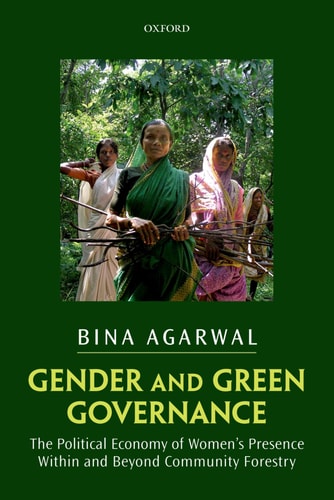
Gender and Green Governance: The Political Economy of Women's Presence Within and Beyond Community Forestry
0
0
As an Amazon Associate and affiliate partner, Menrva Books earns from qualifying purchases. Learn more
Author Description
Economists studying environmental collective action and green governance have paid little attention to gender. Research on gender and green governance in other disciplines has focused mainly on women's near absence from forestry institutions. This interdisciplinary book turns that focus on its head to ask: what if women were present in these institutions? What difference would that make?Would women's inclusion in forest governance - undeniably important for equity - also affect decisions on forest use and outcomes for conservation and subsistence? Are women's interests in forests different from men's? Would women's presence lead to better forests and more equitable access? Does it matter which class of women governs? And how large a presence of women would make an impact? Answers to these questions can prove foundational for effective environmental governance. Yet they have hardly been empirically investigated.In an analysis that is conceptually sophisticated and statistically rigorous, using primary data on community forestry institutions in India and Nepal, this book is the first major study to comprehensively address these wide-ranging issues. It traces women's history of exclusion from public institutions, the factors which constrain their effective participation, and how those constraints can be overcome. It outlines how strategic partnerships between forestry and other civil society institutions could strengthen rural women's bargaining power with community and government. And it examines the complexities of eliciting government accountability in addressing poor rural women's needs, such as for clean domestic fuel and access to the commons.Located in the interface of environmental studies, political economy and gender analysis, the volume makes significant original contributions to current debates on gender and governance, forest conservation, clean energy policy, critical mass and social inclusion. Traversing uncharted territory with rare analytical rigor, th
Menrva's Summary
THE THESIS
This book investigates whether the inclusion of women in community forestry institutions significantly alters forest governance outcomes, conservation efficacy, and equitable resource access. Bina Agarwal, a distinguished economist, utilizes a rigorous interdisciplinary framework to challenge the historical oversight of gender within environmental collective action. By analyzing primary data from India and Nepal, the author evaluates how women's participation—or lack thereof—impacts decision-making processes, subsistence needs, and the broader political economy of natural resource management.
THE SCOPE MAP
What You Will Find
- Primary empirical data collected from community forestry institutions across India and Nepal.
- A conceptual framework analyzing the 'critical mass' theory in the context of institutional governance.
- An examination of the socio-economic barriers preventing effective female participation in public decision-making.
- Strategic policy recommendations for fostering partnerships between forestry institutions and civil society to enhance rural women's bargaining power.
THE AUTHORITY PERSPECTIVE
Experts recognize this work as a foundational text that bridges the gap between gender studies and environmental economics. Scholars frequently cite the book for its methodological rigor and its ability to provide empirical evidence for long-standing theoretical debates regarding social inclusion in governance.
Page Count:
528
Publication Date:
2013-08-24
Publisher:
Oxford University Press
ISBN-10:
0199683026
ISBN-13:
9780199683024
Politics
Forestry
Forests and forestry
NATURE Ecology
Public Policy
Women india
World politics
Gender Studies
Sociology
Women nepal
Community Tags
Other Editions(2)
Similar Books







Reader Comments
Share Your Thoughts
No comments yet. Be the first to share your thoughts!