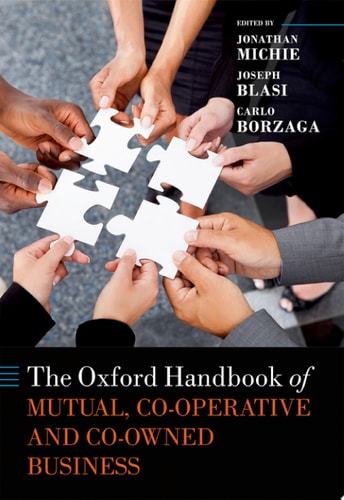
The Oxford Handbook of Mutual, Co-Operative, and Co-Owned Business
0
0
As an Amazon Associate and affiliate partner, Menrva Books earns from qualifying purchases. Learn more
Author Description
The Oxford Handbook of Mutual, Co-Operative, and Co-Owned Business investigates all types of 'member owned' organizations, whether consumer co-operatives, agricultural and producer co-operatives, worker co-operatives, mutual building societies, friendly societies, credit unions, solidarity organizations, mutual insurance companies, or employee-owned companies. Such organizations can be owned by their consumers, the producers, or the employees - whether through single-stakeholder or multi-stakeholder ownership.This complex set of organizations is named differently across countries: from 'mutual' in the UK, to 'solidarity cooperatives' in Latin America. In some countries, such organizations are not even officially recognized and thus lack a specific denomination. For the sake of clarity, this Handbook will refer to member-owned organizations to encompass the variety of non-investor-owned organizations, and in the national case study chapters the terms used will be those most widely employed in that country. These alternative corporate forms have emerged in a variety of economic sectors in almost all advanced economies since the time of the industrial revolution and the development of capitalism, through the subsequent creation and dominance of the limited liability company. Until recently, these organizations were generally regarded as a rather marginal component of the economy. However, over the past few years, member-owned organizations have come to be seen in some countries, at least, as potentially attractive in light of their ability to tackle various economic and social concerns, and their relative resilience during the financial and economic crises of 2007-2017.
Menrva's Summary
THE THESIS
This handbook investigates the economic and social significance of member-owned organizations, questioning how these alternative corporate structures function and persist within capitalist economies. The authors, Carlo Borzaga, Jonathan Michie, and Joseph R. Blasi, compile extensive research to analyze the diverse landscape of co-operatives, mutuals, and employee-owned firms. By examining historical development and contemporary resilience, the text argues that these entities provide a viable, often overlooked, alternative to traditional investor-owned models, particularly in addressing systemic economic crises.
THE SCOPE MAP
What You Will Find
- Comprehensive analysis of diverse organizational forms including credit unions, worker co-operatives, and mutual insurance companies.
- Comparative study of terminology and legal recognition across different national jurisdictions.
- Historical examination of member-owned business evolution since the industrial revolution.
- Evaluation of organizational resilience during the 2007-2017 financial and economic crises.
THE AUTHORITY PERSPECTIVE
Experts identify this volume as a foundational reference for scholars and policymakers interested in non-investor-owned business models. Readers frequently note the academic density of the prose, which provides a rigorous framework for understanding the complexities of global co-operative structures.
Page Count:
544
Publication Date:
2017-05-30
Publisher:
Oxford University Press
ISBN-10:
0199684979
ISBN-13:
9780199684977
Business
Economics
Sociology
Management
Organization Development
Community Tags
Other Editions(2)
Similar Books








Reader Comments
Share Your Thoughts
No comments yet. Be the first to share your thoughts!