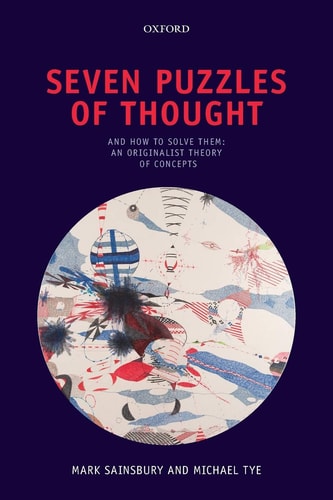
Seven Puzzles of Thought: And How to Solve Them: An Originalist Theory of Concepts
0
0
As an Amazon Associate and affiliate partner, Menrva Books earns from qualifying purchases. Learn more
Author Description
How can one think about the same thing twice without knowing that it's the same thing? How can one think about nothing at all (for example Pegasus, the mythical flying horse)? Is thinking about oneself special? One could mistake one's car for someone else's, but it seems one could not mistake one's own headache for someone else's. Why not?Mark Sainsbury and Michael Tye provide an entirely new theory--called "originalism"-- which provides simple and natural solutions to these puzzles and more. Originalism's central thesis is that concepts, the constituents of thoughts, are to be individuated by their origin, rather than epistemically or semantically. The doctrine has further valuable consequences for the nature of thought, our knowledge of our own thoughts, the nature of experience, the epistemology of perception-based beliefs, and for arguments based on conceivability. Sainsbury and Tye argue that although thought is special, there is no special mystery attaching to the nature of thought. Their account of the mind considers it as part of nature, as opposed to something with supernatural powers--which means that human beings have more opportunities to make mistakes than many have liked to think.
Menrva's Summary
THE THESIS
This book investigates the fundamental nature of concepts and how they constitute human thought by proposing a new framework known as originalism. Authors Michael Tye and R. M. Sainsbury, both established philosophers, utilize this theory to argue that concepts are individuated by their origin rather than by semantic or epistemic properties. By positioning the mind as a natural entity rather than a supernatural one, they provide a systematic approach to resolving long-standing philosophical puzzles regarding self-reference, intentionality, and the possibility of error in thought.
THE SCOPE MAP
What You Will Find
- A detailed exposition of the originalist theory of concepts
- Analysis of classic philosophical puzzles including intentionality toward non-existent objects
- Examination of the nature of self-knowledge and perception-based beliefs
- A naturalistic account of the mind that accounts for human fallibility
THE AUTHORITY PERSPECTIVE
Reader & Expert Consensus: Philosophers and students of cognitive science frequently note the technical rigor of this text as it addresses foundational issues in the philosophy of mind. Experts highlight this work as a significant contribution to the debate on how thoughts relate to their objects and the external world.
Page Count:
206
Publication Date:
2013-09-15
Publisher:
Oxford University Press
ISBN-10:
019968894X
ISBN-13:
9780199688944
Philosophy
Metaphysics
Thought And Thinking
Epistemology