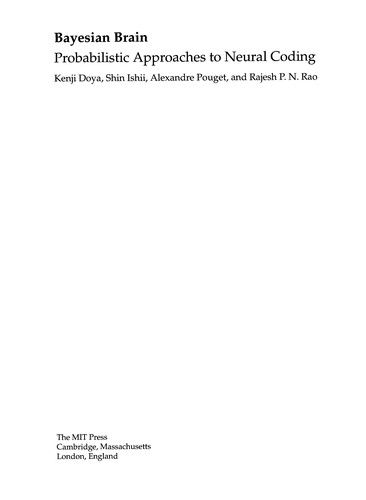
Bayesian Brain
0
0
As an Amazon Associate and affiliate partner, Menrva Books earns from qualifying purchases. Learn more
Author Description
The Bayesian brain hypothesis proposes that the brain operates as a predictive machine, constantly updating its internal models of the world based on sensory input. This book explores how Bayesian inference, a mathematical framework for probabilistic reasoning, can explain a wide range of cognitive functions, from perception and motor control to learning and decision-making. It examines the neural mechanisms that might implement these computations and discusses the implications for understanding both normal brain function and neurological disorders.
Menrva's Summary
THE THESIS
The Bayesian brain hypothesis proposes that the brain operates as a predictive machine, constantly updating its internal models of the world based on sensory input. This book explores how Bayesian inference, a mathematical framework for probabilistic reasoning, can explain a wide range of cognitive functions, from perception and motor control to learning and decision-making. It examines the neural mechanisms that might implement these computations and discusses the implications for understanding both normal brain function and neurological disorders.
THE SCOPE MAP
- Exploration of the Bayesian brain hypothesis as a unifying framework for cognition.
- Detailed examination of how Bayesian inference applies to sensory processing and perception.
- Discussion of Bayesian models in motor control and action planning.
- Analysis of learning and adaptation through the lens of Bayesian inference.
- Application of Bayesian principles to decision-making and reinforcement learning.
- Consideration of the neural implementation of Bayesian computations.
- Implications for understanding brain disorders and developing computational models of the brain.
THE AUTHORITY PERSPECTIVE
The book is recognized as a significant contribution to computational neuroscience, offering a coherent theoretical framework for understanding brain function through the lens of Bayesian inference. It is appreciated for its rigorous approach and its ability to bridge the gap between theoretical probability and empirical neuroscience. The work is considered essential reading for researchers and students interested in the computational principles underlying cognition and the brain's predictive capabilities.
Page Count:
326
Publication Date:
2007-01-01
ISBN-10:
026204238X
ISBN-13:
9780262042383
Science
Non-Fiction
Neuroscience
Community Tags
Similar Books