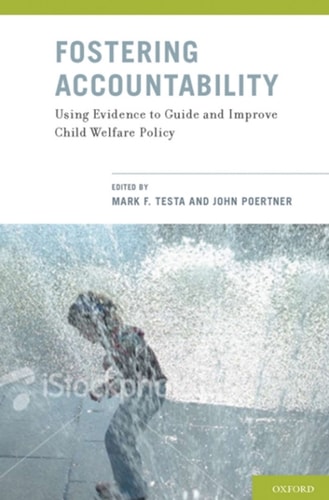
Fostering Accountability: Using Evidence to Guide and Improve Child Welfare Policy
0
0
As an Amazon Associate and affiliate partner, Menrva Books earns from qualifying purchases. Learn more
Author Description
Fostering Accountability presents a model of child welfare decision making that holds public officials answerable for the integrity and validity of the actions they take on behalf of the children and families in their care. It operationalizes the concept of results-oriented accountability, which demands that administrators and practitioners show valid evidence of their success in improving child and family outcomes, not merely demonstrate mechanical procedural compliance.Drawing on the experiences of directors, staff, and evaluators, this timely and practical book describes the emergence of results-oriented accountability in child welfare with a special focus on the editors' role in establishing a university-agency research partnership under a federal consent decree. Chapters elaborate on the five successive stages of the results-oriented accountability framework-outcomes monitoring, data analysis, research review, evaluation, and quality improvement-and provide examples of applications of each stage for agency managers. By refocusing the emphasis on developing policies based on agency data, instead of purely reactive approaches that grasp at solutions and often fall short, Fostering Accountability guides administrators in monitoring outcomes, using evidence to select interventions to enhance results, and applying management strategies to evaluate and improve these efforts.The result is a pragmatic implementation guide for administrators seeking to bring safety, stability, continuity, permanence, and well-being to the lives of abused and neglected children in the United States.
Menrva's Summary
THE THESIS
How can child welfare agencies transition from procedural compliance to a results-oriented accountability framework that prioritizes measurable outcomes for children and families? John Poertner and Mark F. Testa leverage their extensive experience in university-agency research partnerships to propose a systematic model for evidence-based decision making. By integrating data analysis with management strategy, the authors argue that administrators can move beyond reactive policy-making toward a proactive, data-driven approach that ensures safety, stability, and permanence for vulnerable populations.
THE SCOPE MAP
What You Will Find
- A five-stage framework covering outcomes monitoring, data analysis, research review, evaluation, and quality improvement.
- Practical management strategies for implementing evidence-based interventions within public agency structures.
- Case studies derived from university-agency research partnerships operating under federal consent decrees.
- Methodologies for shifting organizational culture from mechanical compliance to outcome-focused accountability.
THE AUTHORITY PERSPECTIVE
Experts in social work and public administration identify this text as a foundational resource for agency leaders seeking to modernize child welfare operations. Readers frequently note the practical utility of the five-stage framework for managers tasked with navigating complex federal and state regulatory environments.
Page Count:
400
Publication Date:
2010-01-01
Publisher:
Oxford University Press
ISBN-10:
0199717486
ISBN-13:
9780199717484
Social Work
English & College Success
Introduction to Social WorkWelfare
Research Methods
Public Policy
Child Welfare
Home Care
Management
Linguistics
English
Community Tags
Similar Books