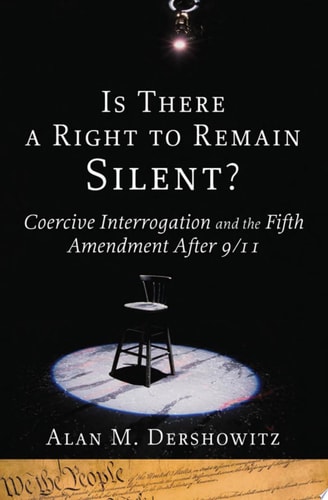
Is There a Right to Remain Silent?: Coercive Interrogation and the Fifth Amendment After 9/11
0
0
As an Amazon Associate and affiliate partner, Menrva Books earns from qualifying purchases. Learn more
Author Description
The right to remain silent, guaranteed by the famed Fifth Amendment case, Miranda v. Arizona, is perhaps one of the most easily recognized and oft-quoted constitutional rights in American culture. Yet despite its ubiquity, there is widespread misunderstanding about the right and the protections promised under the Fifth Amendment.In Is There a Right to Remain Silent? renowned legal scholar and bestselling author Alan Dershowitz reveals precisely why our Fifth Amendment rights matter and how they are being reshaped, limited, and in some cases revoked in the wake of 9/11. As security concerns have heightened, law enforcement has increasingly turned its attention from punishing to preventing crime. Dershowitz argues that recent Supreme Court decisions have opened the door to coercive interrogations—even when they amount to torture—if they are undertaken to prevent a crime, especially a terrorist attack, and so long as the fruits of such interrogations are not introduced into evidence at the criminal trial of the coerced person. In effect, the court has given a green light to all preventive interrogation methods. By deftly tracing the evolution of the Fifth Amendment from its inception in the Bill of Rights to the present day, where national security is the nation's first priority, Dershowitz puts forward a bold reinterpretation of the Fifth Amendment for the post-9/11 world. As the world we live in changes from a "deterrent state" to the heightened vigilance of today's "preventative state," our construction, he argues, must also change. We must develop a jurisprudence that will contain both substantive and procedural rules for all actions taken by government officials in order to prevent harmful conduct-including terrorism.Timely, provocative, and incisively written, Is There a Right to Remain Silent? presents an absorbing look at one of our most essential constitutional rights at one of the most critical moments in recent American history.
Menrva's Summary
THE THESIS
Does the Fifth Amendment right to remain silent retain its constitutional integrity when balanced against the government's mandate to prevent terrorism? Alan M. Dershowitz, a prominent legal scholar and professor, examines the shifting landscape of American jurisprudence following the September 11 attacks. He argues that the transition from a deterrent-based legal system to a preventative state has created a dangerous loophole, allowing for coercive interrogation tactics that bypass traditional constitutional protections.
THE SCOPE MAP
What You Will Find
- Historical evolution of the Fifth Amendment from the Bill of Rights to modern Supreme Court rulings.
- Analysis of the legal distinction between punitive and preventative law enforcement strategies.
- Examination of the implications of coercive interrogation methods, including potential torture, in the context of national security.
- Proposed frameworks for new substantive and procedural rules to govern government conduct in preventing harmful acts.
THE AUTHORITY PERSPECTIVE
Legal scholars and critics note that the text provides a provocative critique of contemporary judicial trends regarding civil liberties. Readers frequently highlight the author's ability to synthesize complex constitutional history into a clear argument regarding the erosion of individual rights in the post-9/11 era.
Page Count:
0
Publication Date:
2008-01-01
Publisher:
Oxford University Press, Incorporated
ISBN-10:
0199719063
ISBN-13:
9780199719068
History
Human rights
Constitutional Law
Law
United States
Right To Counsel
Community Tags
Other Editions(2)

Similar Books


Reader Comments
Share Your Thoughts
No comments yet. Be the first to share your thoughts!