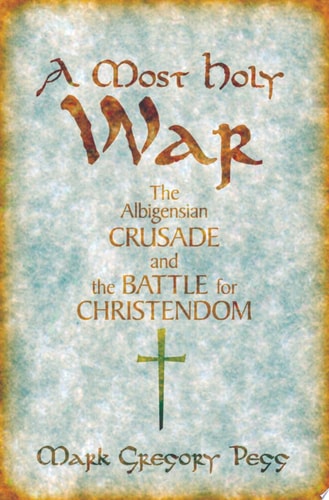
A Most Holy War: The Albigensian Crusade and the Battle for Christendom
0
0
As an Amazon Associate and affiliate partner, Menrva Books earns from qualifying purchases. Learn more
Author Description
In January of 1208, a papal legate was murdered on the banks of the Rhone in southern France. A furious Pope Innocent III accused heretics of the crime and called upon all Christians to exterminate heresy between the Garonne and Rhone rivers--a vast region now known as Languedoc--in a great crusade. This most holy war, the first in which Christians were promised salvation for killing other Christians, lasted twenty bloody years--it was a long savage battle for the soul of Christendom. In A Most Holy War, historian Mark Pegg has produced a swift-moving, gripping narrative of this horrific crusade, drawing in part on thousands of testimonies collected by inquisitors in the years 1235 to 1245. These accounts of ordinary men and women, remembering what it was like to live through such brutal times, bring the story vividly to life. Pegg argues that generations of historians (and novelists) have misunderstood the crusade; they assumed it was a war against the Cathars, the most famous heretics of the Middle Ages. The Cathars, Pegg reveals, never existed. He further shows how a millennial fervor about "cleansing" the world of heresy, coupled with a fear that Christendom was being eaten away from within by heretics who looked no different than other Christians, made the battles, sieges, and massacres of the crusade almost apocalyptic in their cruel intensity. In responding to this fear with a holy genocidal war, Innocent III fundamentally changed how Western civilization dealt with individuals accused of corrupting society. This fundamental change, Pegg argues, led directly to the creation of the inquisition, the rise of an anti-Semitism dedicated to the violent elimination of Jews, andeven the holy violence of the Reconquista in Spain and in the New World in the fifteenth century. All derive their divinely sanctioned slaughter from the Albigensian Crusade. Haunting and immersive, A Most Holy War opens an important new perspective on a truly pivotal moment in world history
Menrva's Summary
THE THESIS
Did the Albigensian Crusade fundamentally alter the trajectory of Western civilization by establishing a precedent for state-sanctioned holy violence? Historian Mark Gregory Pegg examines the twenty-year conflict initiated by Pope Innocent III in 1208, utilizing primary source testimonies from inquisitorial records dated 1235 to 1245. Pegg challenges traditional historiography by arguing that the 'Cathar' identity was a construct rather than a cohesive movement, suggesting instead that the crusade was driven by an apocalyptic desire to purge perceived internal corruption from Christendom.
THE SCOPE MAP
What You Will Find
- A detailed analysis of the Albigensian Crusade in the Languedoc region of southern France.
- Examination of inquisitorial records and witness testimonies from the mid-13th century.
- A critical reassessment of the existence and nature of the Cathar heresy.
- Exploration of how the crusade influenced the development of the Inquisition and later patterns of religious persecution.
THE AUTHORITY PERSPECTIVE
Scholars and historians frequently cite this work for its provocative re-evaluation of medieval heresy and the origins of institutionalized religious violence. Readers often note the author's ability to synthesize dense archival data into a compelling, narrative-driven historical account.
Page Count:
0
Publication Date:
2008-01-01
Publisher:
Ebsco Publishing
ISBN-10:
0199721513
ISBN-13:
9780199721511
History
European History
Crusades
Albigenses
Religious History
Church History
France history
Military History
Community Tags
Other Editions(2)
Similar Books


Reader Comments
Share Your Thoughts
No comments yet. Be the first to share your thoughts!