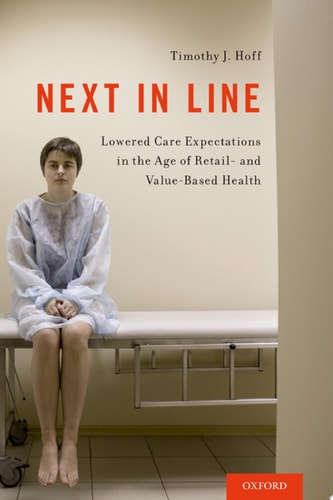
Next in Line: Lowered Care Expectations in the Age of Retail- and Value-Based Health
0
0
As an Amazon Associate and affiliate partner, Menrva Books earns from qualifying purchases. Learn more
Author Description
For all the political branding and rebranding of healthcare in the United States, its fundamental unit of currency remains the doctor-patient relationship. This relationship has undergone seismic changes during the twenty-first century, including the introduction of new players (the so-called healthcare "team") and care delivery in settings like big-box stores and bureaucratic health systems. But are any of us better off?NEXT IN LINE is the first book to examine the doctor-patient relationship in the context of its new environs, in particular the impact of efficiency-driven innovation and retail-care models on physician mindsets and the patient experience. The overall picture is one of lowered expectations-a transactional, impersonal, and institutionally-limited incarnation of the medical bedside that leaves all parties underwhelmed and overstressed.By first conducting a macro-analysis of key industry trends (including the widespread use of performance metrics and retail principles), then measuring these trends' impacts through interviews with physicians and patients, NEXT IN LINE is both an examination and a critique of a care system at a crossroads. It is essential reading for understanding why relational care matters -- and why it must be saved in a corporatized health system bent on using retail approaches to deliver care.
Menrva's Summary
THE THESIS
This book investigates how the shift toward retail-based and efficiency-driven healthcare models has fundamentally altered the doctor-patient relationship, leading to diminished expectations and impersonal care. Timothy J. Hoff, a professor of management, healthcare systems, and health policy, utilizes a combination of industry trend analysis and qualitative interviews to argue that the corporatization of medicine prioritizes metrics over the relational aspects of healing. The work presents a critical framework for understanding the systemic pressures that leave both providers and patients dissatisfied within the modern medical landscape.
THE SCOPE MAP
What You Will Find
- Macro-analysis of healthcare industry trends including performance metrics and retail principles
- Qualitative data derived from interviews with physicians and patients
- Examination of the impact of big-box store clinics and bureaucratic health systems on care delivery
Scope Limits
- The book does not provide a comprehensive legislative roadmap for federal healthcare reform
- It does not focus on the technical efficacy of specific medical treatments or clinical procedures
THE AUTHORITY PERSPECTIVE
Experts recognize this work as a significant contribution to the sociology of medicine, noting its clear articulation of the tension between administrative efficiency and human-centered care. Readers frequently highlight the author's ability to synthesize complex institutional shifts into a coherent critique of the modern medical experience.
Page Count:
247
Publication Date:
2017-01-01
Publisher:
Oxford University Press
ISBN-10:
0190626364
ISBN-13:
9780190626365
Physician & Patient
Public Health
Medical
Sociology
Health Policy
Healthcare Administration
Allied Health
Community Tags
Similar Books