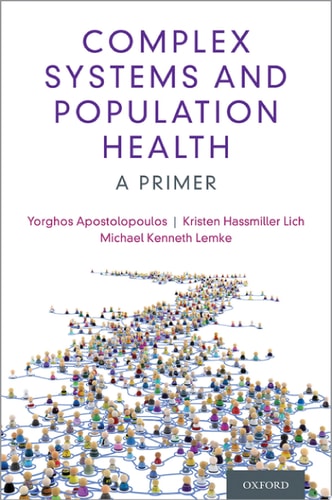
Complex Systems and Population Health
0
0
As an Amazon Associate and affiliate partner, Menrva Books earns from qualifying purchases. Learn more
Author Description
Currently, population health science is an integral part of global academic curricula. For over a century, the principles of the reductionist paradigm have guided population health curricula, training, research, and action. Researchers continue to draw upon these principles when theorizing, conceptualizing, designing studies, analyzing, and devising interventions to tackle complex population health problems. However, unresolved impasses in addressing pressing population health challenges have catalyzed calls for the integration of complex-systems-science-grounded approaches into population health science. Mounting evidence denotes that a complex systems paradigm can bring about dramatic, multipronged changes for education and training, and lead to innovative research, interventions, and policies. Despite the large and untapped promise of complex systems, the haphazard knowledge base from which academics, researchers, students, policymakers, and practitioners can draw has slowed their integration into the population health sciences.This volume fulfils this growing need by providing the knowledge base necessary to introduce a holistic complex systems paradigm in population health science. As such, it is the first comprehensive book in population health science that meaningfully integrates complex systems theory, methodology, modeling, computational simulation, and real-world applications, while incorporating current population health theoretical, methodological and analytical perspectives. It is intended as a programmatic primer across a broad spectrum of population health stakeholders: from university professors and graduate students, to researchers, policymakers, and practitioners.
Menrva's Summary
THE THESIS
This volume investigates how the integration of complex systems science can overcome the limitations of the traditional reductionist paradigm in addressing contemporary population health challenges. The authors, Yorghos Apostolopoulos, Kristen Hassmiller Lich, and Michael K. Lemke, synthesize theoretical frameworks and practical methodologies to provide a comprehensive primer for the field. By bridging the gap between abstract systems theory and applied health research, the text argues for a shift toward holistic modeling and computational simulation to better inform policy and intervention strategies.
THE SCOPE MAP
What You Will Find
- Theoretical foundations of complex systems science in a health context
- Methodologies for computational simulation and systems modeling
- Integration of real-world applications with existing population health research
- Frameworks for academic curricula and professional training
Scope Limits
- Does not provide an exhaustive history of traditional epidemiological methods
- Does not cover specific clinical diagnostic protocols or individual-level medical treatments
THE AUTHORITY PERSPECTIVE
Experts identify this volume as a foundational resource for bridging the gap between systems theory and public health practice. Readers frequently note that the text serves as a necessary bridge for graduate students and policymakers seeking to move beyond reductionist analytical models.
Page Count:
335
Publication Date:
2020-01-01
Publisher:
Oxford University Press
ISBN-10:
0190880767
ISBN-13:
9780190880767
Health Policy
Medical
Allied Health
Systems Science
Complex Systems
Academic Research
Epidemiology
Public Health
Health Care
Community Tags
Similar Books