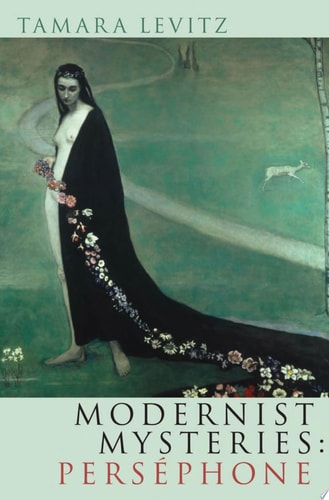
Modernist Mysteries: Perséphone
0
0
As an Amazon Associate and affiliate partner, Menrva Books earns from qualifying purchases. Learn more
Author Description
Modernist Mysteries: Perséphone is a landmark study that will move the field of musicology in important new directions. The book presents a microhistorical analysis of the premiere of the melodrama Perséphone at the Paris Opera on April 30th, 1934, engaging with the collaborative, transnational nature of the production. Author Tamara Levitz demonstrates how these collaborators-- Igor Stravinsky, André Gide, Jacques Copeau, and Ida Rubinstein, among others-used the myth of Persephone to perform and articulate their most deeply held beliefs about four topics significant to modernism: religion, sexuality, death, and historical memory in art. In investigating the aesthetic and political consequences of the artists' diverging perspectives, and the fall-out of their titanic clash on the theater stage, Levitz dismantles myths about neoclassicism as a musical style. The result is a revisionary account of modernism in music in the 1930s.As a result of its focus on the collaborative performance, this book differs from traditional accounts of musical modernism and neoclassicism in several ways. First and foremost, it centers on the performance of modernism, highlighting the theatrical, performative, and sensual. Levitz places Christianity in the center of the discussion, and questions the national distinctions common in modernist research by involving a transnational team of collaborators. She further breaks new ground in shifting the focus from "history" to "memory" by emphasizing the commemorative nature of neoclassic listening rituals over the historicist stylization of its scores, and contends that modernists captured on stage and in philosophical argument their simultaneous need and inability to mourn the past. The book as a whole counters the common criticism that neoclassicism was a "reactionary" musical style by suggesting a more pluralistic, ambivalent, and sometimes even progressive politics, and reconnects musical neoclassicism with a queer classicist tradition.
Menrva's Summary
THE THESIS
Does the 1934 premiere of the melodrama Perséphone reveal a more complex, pluralistic, and politically nuanced understanding of musical neoclassicism than traditional musicological accounts suggest? Tamara Levitz, a scholar in musicology, utilizes a microhistorical framework to examine the collaborative production of Igor Stravinsky and André Gide’s work at the Paris Opera. By analyzing the intersection of religion, sexuality, death, and historical memory, Levitz challenges the long-standing characterization of neoclassicism as a purely reactionary musical style. The text argues that the production serves as a site for understanding the tensions between artistic innovation and the inability to mourn the past.
THE SCOPE MAP
What You Will Find
- A microhistorical analysis of the April 30th, 1934, premiere of Perséphone at the Paris Opera.
- An examination of the collaborative dynamics between Igor Stravinsky, André Gide, Jacques Copeau, and Ida Rubinstein.
- A critical investigation into the role of Christianity and queer classicist traditions within modernist performance.
- A shift in methodology from traditional historicist score analysis to the study of commemorative listening rituals and cultural memory.
THE AUTHORITY PERSPECTIVE
Experts identify this work as a significant intervention in musicological research that successfully challenges established narratives regarding 1930s modernism. Readers frequently note the academic density of the prose and the author's meticulous attention to the transnational and performative aspects of the production.
Page Count:
680
Publication Date:
2012-09-17
Publisher:
Oxford University Press
ISBN-10:
0199730164
ISBN-13:
9780199730162
History
Musicology
Modernism
Criticism history
Gods