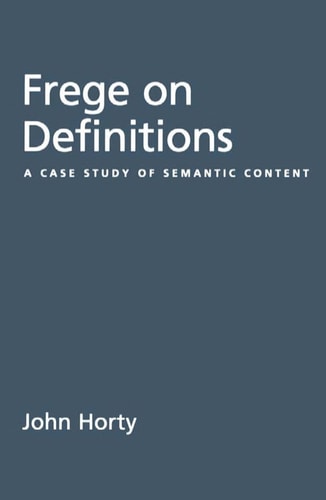
Frege on Definitions: A Case Study of Semantic Content
0
0
As an Amazon Associate and affiliate partner, Menrva Books earns from qualifying purchases. Learn more
Author Description
In this short monograph, John Horty explores the difficulties presented for Gottlob Frege's semantic theory, as well as its modern descendents, by the treatment of defined expressions.The book begins by focusing on the psychological constraints governing Frege's notion of sense, or meaning, and argues that, given these constraints, even the treatment of simple stipulative definitions led Frege to important difficulties. Horty is able to suggest ways out of these difficulties that are both philosophically and logically plausible and Fregean in spirit. This discussion is then connected to a number of more familiar topics, such as indexicality and the discussion of concepts in recent theories of mind and language.In the latter part of the book, after introducing a simple semantic model of senses as procedures, Horty considers the problems that definitions present for Frege's idea that the sense of an expression should mirror its grammatical structure. The requirement can be satisfied, he argues, only if defined expressions--and incomplete expressions as well--are assigned senses of their own, rather than treated contextually. He then explores one way in which these senses might be reified within the procedural model, drawing on ideas from work in the semantics of computer programming languages.With its combination of technical semantics and history of philosophy, Horty's book tackles some of the hardest questions in the philosophy of language. It should interest philosophers, logicians, and linguists.
Menrva's Summary
THE THESIS
This monograph investigates the inherent tensions within Gottlob Frege’s semantic theory regarding the treatment of defined expressions and their relationship to psychological constraints. John F. Horty, a scholar in philosophy and logic, examines how Frege’s notion of sense struggles with stipulative definitions. By analyzing the intersection of historical philosophy and modern semantic modeling, Horty proposes a procedural framework to resolve these logical inconsistencies while maintaining a Fregean perspective.
THE SCOPE MAP
What You Will Find
- Analysis of psychological constraints governing the Fregean notion of sense.
- A procedural semantic model that treats senses as computational processes.
- Examination of the relationship between grammatical structure and semantic content.
- Integration of concepts from computer programming language semantics into philosophical discourse.
THE AUTHORITY PERSPECTIVE
Experts recognize this work as a rigorous contribution to the philosophy of language that bridges historical analysis with contemporary technical semantics. Readers frequently note the density of the prose, which requires a strong background in logic and formal semantics to fully appreciate the proposed solutions.
Page Count:
176
Publication Date:
2009-11-20
Publisher:
Oxford University Press
ISBN-10:
019973271X
ISBN-13:
9780199732715
Philosophy
Linguistics
Logic
Semantics
Community Tags
Similar Books