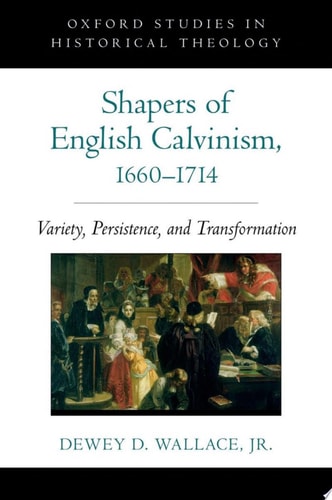
Shapers of English Calvinism, 1660-1714: Variety, Persistence, and Transformation
0
0
As an Amazon Associate and affiliate partner, Menrva Books earns from qualifying purchases. Learn more
Author Description
Dewey Wallace tells the story of several prominent English Calvinist actors and thinkers in the first generations after the beginning of the Restoration. He seeks to overturn conventional clichés about Calvinism: that it was anti-mystical, that it allowed no scope for the ''ancient theology'' that characterized much of Renaissance learning, that its piety was harshly predestinarian, that it was uninterested in natural theology, and that it had been purged from the established church by the end of the seventeenth century.In the midst of conflicts between Church and Dissent and the intellectual challenges of the dawning age of Enlightenment, Calvinist individuals and groups dealt with deism, anti-Trinitarianism, and scoffing atheism--usually understood as godlessness--by choosing different emphases in their defense and promotion of Calvinist piety and theology. Wallace shows that in each case, there was not only persistence in an earlier Calvinist trajectory, but also a transformation of the Calvinist heritage into a new mode of thinking and acting. The different paths taken illustrate the rich variety of English Calvinism in the period.This study presents description and analysis of the mystical Calvinism of Peter Sterry, the hermeticist Calvinism of Theophilus Gale, the evangelical Calvinism of Joseph Alleine and the circle that promoted his legacy, the natural theology of the moderate Calvinist Presbyterians Richard Baxter, William Bates, and John Howe, and the Church of England Calvinism of John Edwards. Shapers of English Calvinism, 1660-1714 illuminates the religious and intellectual history of the era between the Reformation and modernity, offering fascinating insight into the development of Calvinism and also into English Puritanism as it transitioned into Dissent.
Menrva's Summary
THE THESIS
This work investigates how English Calvinism evolved and persisted within the complex religious and intellectual landscape of the late seventeenth and early eighteenth centuries. Dewey D. Wallace Jr. utilizes a biographical and thematic approach to challenge historical stereotypes that characterize Calvinism as a monolithic, anti-mystical, or purely predestinarian tradition. By examining the writings and actions of key figures during the Restoration and the dawn of the Enlightenment, the author demonstrates that Calvinism was a dynamic, adaptable framework that engaged directly with contemporary challenges like deism and natural theology.
THE SCOPE MAP
What You Will Find
- Analysis of the transition from Puritanism to Dissent in post-1660 England.
- Examination of diverse theological expressions, including mystical, hermeticist, and evangelical Calvinism.
- Case studies of prominent thinkers such as Peter Sterry, Theophilus Gale, Richard Baxter, and John Edwards.
- Exploration of how Calvinist thought interacted with Renaissance learning and early Enlightenment intellectual currents.
THE AUTHORITY PERSPECTIVE
Scholars recognize this text as a significant contribution to the study of post-Restoration religious history, noting its success in dismantling simplistic narratives regarding the decline of Calvinist influence. Readers frequently highlight the academic density of the prose and the author's meticulous attention to the nuanced theological shifts within the established church and dissenting circles.
Page Count:
368
Publication Date:
2011-05-30
Publisher:
Oxford University Press
ISBN-10:
0199744831
ISBN-13:
9780199744831
History
Theology
Intellectual History
Puritanism
Christianity
Calvinism
Reformed Church
Reformation
Community Tags
Similar Books