
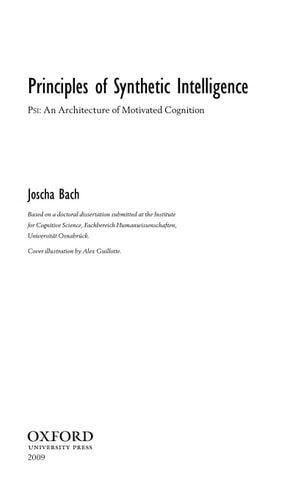
Principles of Synthetic Intelligence: Psi: An Architecture of Motivated Cognition
0
0
As an Amazon Associate and affiliate partner, Menrva Books earns from qualifying purchases. Learn more
Author Description
From the Foreword:"In this book Joscha Bach introduces Dietrich Dörner's PSI architecture and Joscha's implementation of the MicroPSI architecture. These architectures and their implementation have several lessons for other architectures and models. Most notably, the PSI architecture includes drives and thus directly addresses questions of emotional behavior. An architecture including drives helps clarify how emotions could arise. It also changes the way that the architecture works on a fundamental level, providing an architecture more suited for behaving autonomously in a simulated world. PSI includes three types of drives, physiological (e.g., hunger), social (i.e., affiliation needs), and cognitive (i.e., reduction of uncertainty and expression of competency). These drives routinely influence goal formation and knowledge selection and application. The resulting architecture generates new kinds of behaviors, including context dependent memories, socially motivated behavior, and internally motivated task switching. This architecture illustrates how emotions and physical drives can be included in an embodied cognitive architecture.The PSI architecture, while including perceptual, motor, learning, and cognitive processing components, also includes several novel knowledge representations: temporal structures, spatial memories, and several new information processing mechanisms and behaviors, including progress through types of knowledge sources when problem solving (the Rasmussen ladder), and knowledge-based hierarchical active vision. These mechanisms and representations suggest ways for making other architectures more realistic, more accurate, and easier to use.The architecture is demonstrated in the Island simulated environment. While it may look like a simple game, it was carefully designed to allow multiple tasks to be pursued and provides ways to satisfy the multiple drives. It would be useful in its own right for developing other architectures interested in mult
Menrva's Summary
THE THESIS
This book investigates the integration of emotional drives and motivated cognition into artificial intelligence architectures to achieve autonomous behavior. Joscha Bach presents the PSI architecture, originally developed by Dietrich Dörner, and his own implementation, MicroPSI. By incorporating physiological, social, and cognitive drives, the work argues that emotional behavior is a functional necessity for agents operating in complex, simulated environments. The text provides a rigorous framework for how these internal states influence goal formation, memory, and task switching.
THE SCOPE MAP
What You Will Find
- A detailed breakdown of the PSI architecture and its implementation in MicroPSI.
- Analysis of three primary drive categories: physiological, social, and cognitive.
- Examination of novel knowledge representations including temporal structures and spatial memories.
- Practical demonstration of the architecture within the Island simulated environment.
- Integration of the Rasmussen ladder for problem-solving and hierarchical active vision.
THE AUTHORITY PERSPECTIVE
Experts recognize this work as a foundational text for researchers interested in embodied cognitive architectures and the intersection of psychology and AI. Readers frequently note the technical density of the prose, which requires a strong background in cognitive modeling to fully appreciate the implementation details.
Page Count:
400
Publication Date:
2009-01-01
Publisher:
Oxford University Press
ISBN-10:
0199745706
ISBN-13:
9780199745708
Psychology
Robotics
Computer Science
Community Tags
Other Editions(2)

Similar Books






Reader Comments
Share Your Thoughts
No comments yet. Be the first to share your thoughts!