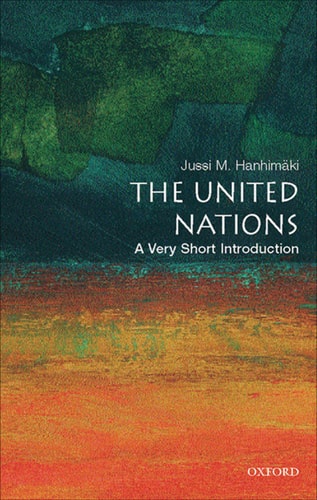
The United Nations: A Very Short Introduction
0
0
As an Amazon Associate and affiliate partner, Menrva Books earns from qualifying purchases. Learn more
Author Description
The United Nations has been called everything from "the best hope of mankind" to "irrelevant" and "obsolete." With this much-needed introduction to the UN, Jussi Hanhimäki engages the current debate over the organizations effectiveness as he provides a clear understanding of how it was originally conceived, how it has come to its present form, and how it must confront new challenges in a rapidly changing world.After a brief history of the United Nations and its predecessor, the League of Nations, the author examines the UN's successes and failures as a guardian of international peace and security, as a promoter of human rights, as a protector of international law, and as an engineer of socio-economic development. Hanhimäki stresses that the UN's greatest problem has been the impossibly wide gap between its ambitions and capabilities. In the area of international security, for instance, the UN has to settle conflicts--be they between or within states--without offending the national sovereignty of its member states, and without being sidelined by strong countries, as happened in the 2003 intervention of Iraq. Hanhimäki also provides a clear accounting of the UN and its various arms and organizations (such as UNESCO and UNICEF), and he offers a critical overview of how effective it has been in the recent crises in Rwanda and the former Yugoslavia, for example--and how likely it is to meet its overall goals in the future.The United Nations, Hanhimäki concludes, is an indispensable organization that has made the world a better place. But it is also a deeply flawed institution, in need of constant reform.
Menrva's Summary
THE THESIS
This volume investigates the core question of whether the United Nations remains a relevant and effective institution in a world defined by shifting geopolitical power and complex international crises. Jussi M. Hanhimäki, a professor of international history, utilizes a historical framework to evaluate the organization's evolution from the League of Nations to its current structure. He argues that the central tension of the UN lies in the persistent gap between its expansive humanitarian ambitions and its limited operational capabilities. By examining specific case studies, the author provides a balanced assessment of the institution's successes and its systemic failures.
THE SCOPE MAP
What You Will Find
- A historical overview of the UN and its predecessor, the League of Nations.
- An analysis of the UN's role in international security, human rights, and socio-economic development.
- Case studies of institutional performance in Rwanda, the former Yugoslavia, and the 2003 Iraq intervention.
- A structural breakdown of the UN's various arms, including UNESCO and UNICEF.
THE AUTHORITY PERSPECTIVE
Experts and students frequently cite this work as a foundational, accessible primer for understanding the complexities of global governance. Readers note that the prose is concise and maintains a neutral, analytical tone despite the contentious nature of the subject matter.
Page Count:
180
Publication Date:
2008-01-01
Publisher:
Oxford University Press
ISBN-10:
0199743754
ISBN-13:
9780199743759
History
Politics
International relations
United Nations
European History
Sociology
Government
Law Courts
Public Administration
Community Tags
Other Editions(2)
Similar Books