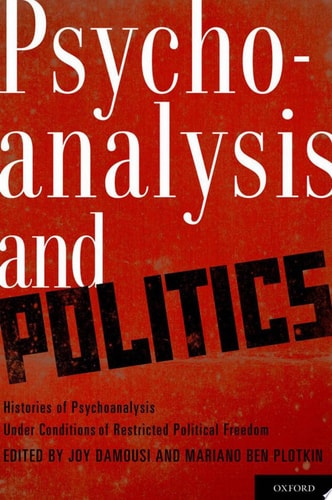
Psychoanalysis and Politics: Histories of Psychoanalysis Under Conditions of Restricted Political Freedom
0
0
As an Amazon Associate and affiliate partner, Menrva Books earns from qualifying purchases. Learn more
Author Description
More than just a therapeutic technique, psychoanalysis as a school of thought has redefined our ideas on sexuality, the self, morality, family, and the nature of the mind for much of the twentieth century. At its broadest, Freud's thinking on civilization and social forces provides a context in which to consider the history of political struggle among individuals and societies. This volume explores a central paradox in the evolution of psychoanalytic thought and practice and the ways in which they were used. Why and how have some authoritarian regimes utilized psychoanalytic concepts of the self to envisage a new social and political order? How did psychoanalysis provide both theoretical and practical elements to legitimize resistance to those same regimes? How can a school of thought be co-opted so deftly by different groups for different political ends?Bringing together contributions from innovative scholars of history, politics, and psychoanalysis, this volume analyzes the various outcomes of this fascinating and influential theory's development under a wide spectrum of governments that restricted political and cultural freedoms from the 1930s to the present. The regimes analyzed range from Fascist Italy, Vichy France, and Spain and Hungary under Fascism and Communism; modern Latin American dictatorships, such as Brazil and Argentina in the 1960s and 1970s; and the influence of Hoover, McCarthy, and the larger Cold War on psychoanalysis in America.A fresh addition to an enormous body of scholarship, this will be required reading for academics interested in the relationship between politics and non-political systems of thoughts and beliefs, the transnational circulation of ideas, social movements, and the intellectual and social history of psychoanalysis.
Menrva's Summary
THE THESIS
This volume investigates the complex paradox of how psychoanalytic theory has been simultaneously utilized by authoritarian regimes to enforce social control and by dissident groups to legitimize resistance to those same powers. Editors Joy Damousi and Mariano Ben Plotkin curate a collection of scholarly essays that examine the transnational circulation of Freudian concepts. By analyzing the intersection of clinical practice and state power, the contributors argue that psychoanalysis functions as a malleable intellectual framework capable of being co-opted for vastly different political ends across the twentieth century.
THE SCOPE MAP
What You Will Find
- Comparative analysis of psychoanalytic application under Fascist Italy, Vichy France, and Cold War-era regimes in Latin America.
- Examination of the influence of political figures like Hoover and McCarthy on the development of American psychoanalytic institutions.
- Case studies detailing the tension between therapeutic neutrality and state-mandated social engineering.
- Theoretical frameworks for understanding how psychological concepts of the self are leveraged to construct new social and political orders.
THE AUTHORITY PERSPECTIVE
Experts identify this collection as a significant contribution to the intellectual history of the twentieth century, noting its success in bridging the gap between clinical psychology and political science. Readers frequently highlight the academic density of the prose, which provides a rigorous examination of how non-political systems of thought are inevitably shaped by the political environments in which they operate.
Page Count:
320
Publication Date:
2012-02-02
Publisher:
Oxford University Press
ISBN-10:
0199744661
ISBN-13:
9780199744664
History
Psychology
Psychoanalysis
Social History
Movements
Introduction to Social WorkWelfare
Intellectual History
Community Tags
Similar Books