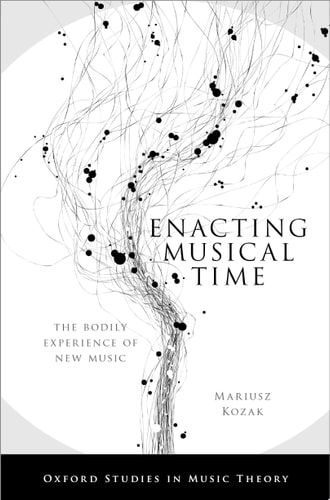
Enacting Musical Time: The Bodily Experience of New Music
0
0
As an Amazon Associate and affiliate partner, Menrva Books earns from qualifying purchases. Learn more
Author Description
What is musical time? Where is it manifested? How does it enter into our experience, and how do we capture it in our analyses? A compelling approach among works on temporality, phenomenology, and the ecologies of the new sound worlds, Enacting Musical Time argues that musical time is itself the site of the interaction between musical sounds and a situated, embodied listener, created by the moving bodies of participants engaged in musical activities. Author Mariusz Kozak describes musical time as something that emerges when the listener enacts her implicit knowledge about "how music goes," from deliberate inactivity, to such simple actions as tapping her foot in time with the beat, to dancing in a way that engages her entire body.Kozak explores this idea in the context of modernist and postmodernist musical styles, where composers create unfamiliar and idiosyncratic temporal experiences, blur the line between spectatorship and participation, and challenge conventional notions of form. Basing his discussion on the phenomenology of Merleau-Ponty and on the ecological psychology of J. J. Gibson, Kozak examines different aspects of musical structure through the lens of embodied cognition and what phenomenologists call "lived time." A bold new theory derived from an unprecedented fusion of research perspectives, Enacting Musical Time will engage scholars across a range of disciplines, from music theory, music cognition, cognitive science, continental philosophy, and social anthropology.
Menrva's Summary
THE THESIS
This book investigates the nature of musical time by proposing that it is not an abstract property of sound, but an emergent phenomenon created through the interaction between musical stimuli and a physically situated listener. Author Mariusz Kozak, a scholar in music theory and cognition, synthesizes the phenomenological frameworks of Maurice Merleau-Ponty with the ecological psychology of J. J. Gibson. He argues that musical time is enacted through the listener's bodily engagement, ranging from subtle internal responses to overt physical movement, thereby challenging traditional analytical approaches that treat time as a static structural element.
THE SCOPE MAP
What You Will Find
- Theoretical framework integrating embodied cognition and phenomenology.
- Analysis of modernist and postmodernist musical compositions.
- Examination of the continuum between passive spectatorship and active participation.
- Application of ecological psychology to the perception of musical form.
Scope Limits
- The text does not provide a comprehensive history of Western musical notation or rhythm.
- It does not focus on traditional tonal music analysis, prioritizing idiosyncratic temporal structures instead.
THE AUTHORITY PERSPECTIVE
Scholars in music theory and cognitive science recognize this work as a significant contribution to the study of embodied listening and temporal perception. Readers frequently note the academic density of the prose, which requires a foundational understanding of both phenomenological philosophy and contemporary music theory to fully grasp the author's arguments.
Page Count:
322
Publication Date:
2019-01-01
Publisher:
Oxford University Press
ISBN-10:
0190080221
ISBN-13:
9780190080228
Philosophy
Music Technology
Phenomenology
Criticism history
Humanities
Music theory
Anthropology
Musicology
Community Tags
Similar Books