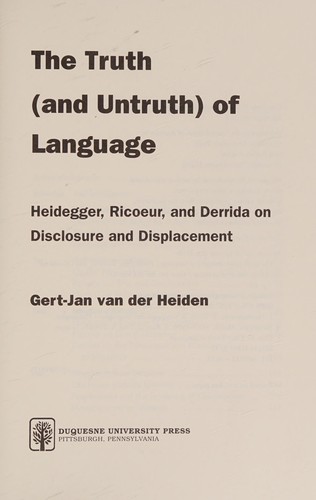
The Truth (and Untruth) of Language
0
0
As an Amazon Associate and affiliate partner, Menrva Books earns from qualifying purchases. Learn more
Author Description
Throughout the history of philosophy, the truth of language has often been considered from the perspective of the distinction between language that serves the transparency and univocality to which philosophy strives and language that threatens this goal. Linguistic phenomena such as writing, metaphor, and poetic mimesis are often considered examples of the latter form, and as a result, treacherous to truth; they would exemplify the "seduction of language," as Husserl beautifully called it. Against this background, it is remarkable that contemporary hermeneutics often inquires into the relation between truth and language by taking these seductive forms of language as a point of departure. Contemporary hermeneutics does so in order to provide a new understanding of truth and untruth in relation to language. In this study, Gert-Jan van der Heiden shows that this hermeneutic understanding of the relation between truth, untruth, and language can be clarified by inquiring into the meaning of two notions: disclosure and displacement. Unconcealment and hiding, truth and untruth, disclosure and displacement are the key notions to understanding the various conceptions of language in contemporary approaches to hermeneutics in continental philosophy. By painting a picture of the different meanings of these concepts in the work of Heidegger, Ricoeur, and Derrida, illuminating the differences and affinities of their respective projects, he finds an original way of showing how these three thinkers mutually discuss the relation between truth and language. The Truth (and Untruth) of Language also confirms Heidegger's continued influence in contemporary debates by tracing the influence of his account of the disclosure and displacement of language in the reigning schools of hermeneutical thought in continental philosophy. As a result, he offers a clear account of the comparison between hermeneutics and deconstruction by elucidating Ricoeur and Derrida's shared resource of Heidegg
Menrva's Summary
THE THESIS
This book investigates the complex relationship between language, truth, and untruth as understood through the lens of contemporary hermeneutics. It examines how philosophical traditions have grappled with language's potential for transparency versus its capacity for deception, particularly through phenomena like writing and metaphor. The study focuses on the concepts of disclosure and displacement to clarify these dynamics within the works of key continental philosophers.
THE SCOPE MAP
- Analysis of philosophical perspectives on language and truth throughout history.
- Exploration of phenomena like writing, metaphor, and poetic mimesis as potentially treacherous to truth.
- Examination of contemporary hermeneutics' approach to truth and untruth in language.
- Focus on the key notions of disclosure and displacement in understanding language.
- Detailed analysis of the works of Heidegger, Ricoeur, and Derrida.
- Illumination of the differences and affinities between their philosophical projects.
- Confirmation of Heidegger's continued influence in continental philosophy.
- Elucidation of the comparison between hermeneutics and deconstruction.
THE AUTHORITY PERSPECTIVE
The book offers a detailed examination of how contemporary hermeneutics engages with the concepts of truth and untruth in language, using disclosure and displacement as central analytical tools. It traces the influence of Heidegger's thought on subsequent thinkers like Ricoeur and Derrida, providing a nuanced comparison of their approaches to language and truth. The work is positioned as a significant contribution to understanding the ongoing philosophical debates within continental philosophy regarding the nature of language and its relation to truth.
Page Count:
296
Publication Date:
2010-01-01
ISBN-10:
0820704342
ISBN-13:
9780820704340
Philosophy
Non-Fiction
Linguistics
Literary Criticism
Community Tags
Similar Books