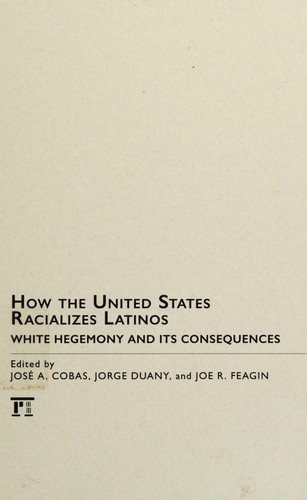
How the United States Racializes Latinos
0
0
As an Amazon Associate and affiliate partner, Menrva Books earns from qualifying purchases. Learn more
Author Description
Mexican and Central American undocumented immigrants, as well as U.S. citizens such as Puerto Ricans and Mexican Americans, have become a significant portion of the U.S. population. Yet the U.S. government, mainstream society, and radical activists characterize this rich diversity of peoples and cultures as one group alternatively called 'Hispanics,' 'Latinos,' or even the pejorative 'illegals.' How has this racializing of populations engendered governmental policies, police profiling, economic exploitation, and even violence that afflict these groups? From a variety of settings--New York, New Jersey, Los Angeles, Central America, Cuba--this book explores this question in considering both the national and international implications of U.S. policy. Its coverage ranges from legal definitions and practices to popular stereotyping by the public and the media, covering such diverse topics as racial profiling, workplace discrimination, mob violence, treatment at border crossings, barriers to success in schools, and many more. It shows how government and social processes of racializing are too seldom understood by mainstream society, and the implication of attendant policies are sorely neglected.
Menrva's Summary
THE THESIS
This book investigates how diverse populations of Latin American origin in the United States are collectively racialized into a single, often marginalized, group. It examines the governmental policies, societal perceptions, and activist categorizations that flatten the rich diversity of Hispanic and Latino peoples into monolithic labels like 'Hispanics,' 'Latinos,' or 'illegals.' The author explores the consequences of this racialization, including policy-driven discrimination, police profiling, economic exploitation, and violence, drawing on examples from various U.S. and international settings to illustrate the national and global implications of these processes.
THE SCOPE MAP
- Analysis of legal definitions and governmental practices in racializing Latino populations.
- Examination of popular stereotyping by the public and media.
- Case studies on racial profiling and workplace discrimination.
- Discussion of mob violence and treatment at border crossings.
- Exploration of barriers to educational success for Latino communities.
- Consideration of both national and international implications of U.S. policy on these groups.
THE AUTHORITY PERSPECTIVE
The book critically examines the processes by which the U.S. government and society construct and apply racial categories to diverse Latin American populations. It highlights how these racializing processes lead to significant policy implications, including discrimination and exploitation. The work draws on a range of settings to illustrate the complex interplay between national and international factors in shaping these experiences. The author's analysis underscores the often-unseen societal and governmental mechanisms that contribute to the marginalization of these communities.
Page Count:
264
Publication Date:
2009-01-01
ISBN-10:
1594515980
ISBN-13:
9781594515989
Politics
Non-Fiction
Science
History
Sociology
Race Relations