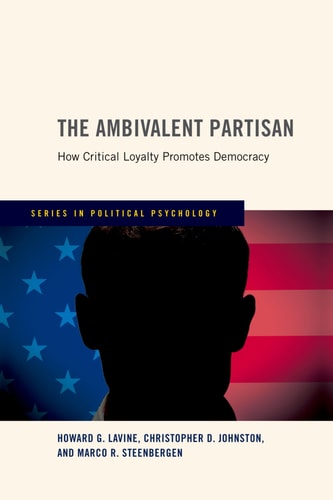
The Ambivalent Partisan: How Critical Loyalty Promotes Democracy
0
0
As an Amazon Associate and affiliate partner, Menrva Books earns from qualifying purchases. Learn more
Author Description
Over the past half century, two overarching questions have dominated the study of mass political behavior: How do ordinary citizens form their political judgments, and how good are those judgments from a normative perspective? The authors of The Ambivalent Partisan offer a novel approach to these questions, one in which political reasoning is viewed as arising from trade-offs among three generally conflicting psychological goals: making decisions easily, getting them right, and maintaining cognitive consistency. Taking aim at decades of received wisdom, the central claim of this book is that high-quality political judgment hinges less on citizens' cognitive ability than on their willingness to temporarily suspend partisan habits and follow the "evidence" wherever it leads. This occurs most readily when citizens experience a disjuncture between their stable political identities and their contemporary evaluations of party performance, a state the authors refer to as partisan ambivalence. Drawing on both experimental and survey methods -- as well as five decades of American political history -- the authors demonstrate that compared to other citizens, ambivalent partisans perceive the political world accurately, form their policy preferences in a principled manner, and communicate those preferences by making issues an important component of their electoral decisions. The book's most important conclusion is that a non-trivial portion of the electorate manages to escape the vicissitudes of apathy or wanton bias, and it is these citizens -- these ambivalent partisans -- who reliably approximate a desirable standard of democratic citizenship.
Menrva's Summary
THE THESIS
This book investigates whether partisan ambivalence serves as a functional mechanism for high-quality political judgment within a democratic framework. The authors, Christopher D. Johnston, Howard G. Lavine, and Marco R. Steenbergen, utilize a psychological framework that models political reasoning as a trade-off between cognitive ease, accuracy, and consistency. By challenging the traditional view that cognitive ability is the primary driver of political competence, they argue that the willingness to prioritize evidence over partisan identity is the true indicator of effective citizenship.
THE SCOPE MAP
What You Will Find
- A psychological model of political reasoning based on competing cognitive goals.
- Analysis of five decades of American political history and electoral behavior.
- Empirical evidence derived from both experimental studies and large-scale survey data.
- A re-evaluation of the role of partisan identity in shaping policy preferences and electoral decisions.
THE AUTHORITY PERSPECTIVE
Experts recognize this work as a significant contribution to political psychology, particularly for its nuanced challenge to conventional theories regarding voter bias. Readers frequently note the academic density of the prose, which is well-suited for scholars and students of political behavior seeking a rigorous examination of democratic citizenship.
Page Count:
320
Publication Date:
2012-11-13
Publisher:
Oxford University Press
ISBN-10:
0199772754
ISBN-13:
9780199772759
Political Psychology
Sociology
Voting
Democracy
Political Behavior
Community Tags
Similar Books