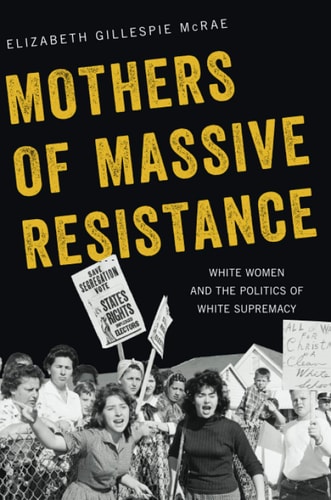
Mothers of Massive Resistance: White Women and the Politics of White Supremacy
0
0
As an Amazon Associate and affiliate partner, Menrva Books earns from qualifying purchases. Learn more
Author Description
Why do white supremacist politics in America remain so powerful? Elizabeth Gillespie McRae argues that the answer lies with white women.Examining racial segregation from 1920s to the 1970s, Mothers of Massive Resistance explores the grassroots workers who maintained the system of racial segregation and Jim Crow. For decades in rural communities, in university towns, and in New South cities, white women performed myriad duties that upheld white over black: censoring textbooks, denying marriage certificates, deciding on the racial identity of their neighbors, celebrating school choice, canvassing communities for votes, and lobbying elected officials. They instilled beliefs in racial hierarchies in their children, built national networks, and experimented with a color-blind political discourse. Without these mundane, everyday acts, white supremacist politics could not have shaped local, regional, and national politics the way it did or lasted as long as it has.With white women at the center of the story, the rise of postwar conservatism looks very different than the male-dominated narratives of the resistance to Civil Rights. Women like Nell Battle Lewis, Florence Sillers Ogden, Mary Dawson Cain, and Cornelia Dabney Tucker publicized threats to their Jim Crow world through political organizing, private correspondence, and journalism. Their efforts began before World War II and the Brown decision and persisted past the 1964 Civil Rights Act and anti-busing protests. White women's segregationist politics stretched across the nation, overlapping with and shaping the rise of the New Right. Mothers of Massive Resistance reveals the diverse ways white women sustained white supremacist politics and thought well beyond the federal legislation that overturned legal segregation.
Menrva's Summary
THE THESIS
Elizabeth Gillespie McRae investigates how white women served as the primary architects and maintainers of white supremacist politics in the United States from the 1920s through the 1970s. McRae, a historian, utilizes extensive archival research, including private correspondence, journalism, and political records, to challenge male-centric narratives of the resistance to Civil Rights. She argues that the endurance of segregationist systems relied heavily on the mundane, grassroots labor of white women who enforced racial hierarchies in schools, local government, and community organizations.
THE SCOPE MAP
What You Will Find
- Analysis of segregationist activities from the 1920s to the 1970s
- Examination of white women's roles in textbook censorship and marriage certificate denial
- Documentation of national segregationist networks and political lobbying efforts
- Case studies of figures like Nell Battle Lewis and Mary Dawson Cain
Scope Limits
- The text focuses primarily on the domestic and grassroots political sphere rather than federal legislative debates
- It does not provide an exhaustive biography of every individual mentioned but uses them as representative examples of broader political trends
THE AUTHORITY PERSPECTIVE
Historians and political scientists frequently cite this work for its contribution to understanding the gendered dimensions of white supremacy. Readers often note the meticulous archival detail and the clarity with which McRae connects local grassroots actions to the broader rise of the American New Right.
Page Count:
368
Publication Date:
2020-03-02
Publisher:
Oxford University Press
ISBN-10:
0190088397
ISBN-13:
9780190088392
History
Sociology
American History
Womens Studies
Political Activity
United States
Segregation
Racism
Civil Rights
Women
Community Tags
Other Editions(2)

Similar Books






Reader Comments
Share Your Thoughts
No comments yet. Be the first to share your thoughts!