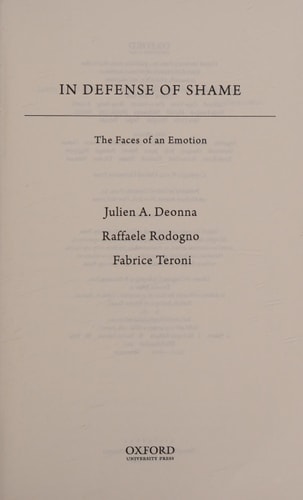
In Defense of Shame: The Faces of an Emotion
0
0
As an Amazon Associate and affiliate partner, Menrva Books earns from qualifying purchases. Learn more
Author Description
Is shame social? Is it superficial? Is it a morally problematic emotion? Researchers in disciplines as different as psychology, philosophy, and anthropology have thought so. But what is the nature of shame and why are claims regarding its social nature and moral standing interesting and important? Do they tell us anything worthwhile about the value of shame and its potential legal and political applications?In this book, Julien A. Deonna, Raffaele Rodogno, and Fabrice Teroni propose an original philosophical account of shame aimed at answering these questions. The book begins with a detailed examination of the evidence and arguments that are taken to support what they call the two dogmas about shame: its alleged social nature and its morally dubious character. Their analysis is conducted against the backdrop of a novel account of shame and ultimately leads to the rejection of these two dogmas. On this account, shame involves a specific form of negative evaluation that the subject takes towards herself: a verdict of incapacity with regard to values to which she is attached. One central virtue of the account resides in the subtle manner it clarifies the ways in which the subject's identity is at stake in shame, thus shedding light on many aspects of this complex emotion and allowing for a sophisticated understanding of its moral significance.This philosophical account of shame engages with all the current debates on shame as they are conducted within disciplines as varied as ethics, moral, experimental, developmental and evolutionary psychology, anthropology, legal studies, feminist studies, politics and public policy.
Menrva's Summary
THE THESIS
This book investigates the nature of shame by challenging the prevailing dogmas that characterize it as inherently social and morally problematic. The authors, Julien A. Deonna, Raffaele Rodogno, and Fabrice Teroni, utilize a rigorous philosophical framework to deconstruct existing psychological and anthropological arguments. By proposing a new account of shame as a negative self-evaluation regarding one's capacity to uphold personal values, they argue that shame is a fundamental aspect of identity rather than merely a social construct.
THE SCOPE MAP
What You Will Find
- A critical analysis of the two primary dogmas regarding shame's social nature and moral dubiousness.
- A novel philosophical definition of shame as a verdict of incapacity toward personal values.
- Interdisciplinary synthesis incorporating ethics, developmental psychology, evolutionary biology, and legal studies.
- An exploration of how shame impacts individual identity and its potential implications for public policy.
THE AUTHORITY PERSPECTIVE
Experts recognize this work as a significant contribution to the philosophy of emotions, particularly for its systematic dismantling of long-held assumptions in the field. Readers frequently note the academic density of the prose, which makes it a foundational text for scholars and advanced students interested in moral psychology.
Page Count:
288
Publication Date:
2011-11-24
Publisher:
Oxford University Press
ISBN-10:
0199793530
ISBN-13:
9780199793532
Psychology
Philosophy
Social Science
Shame
Anthropology
Ethics
Community Tags
Similar Books