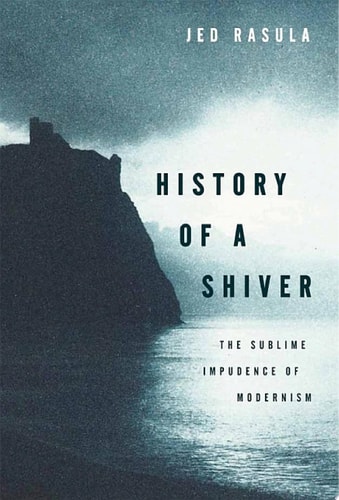
History of a Shiver: The Sublime Impudence of Modernism
0
0
As an Amazon Associate and affiliate partner, Menrva Books earns from qualifying purchases. Learn more
Author Description
An abrupt break in the prevailing modes of artistic expression, for many, marks the advent of modernism in the early twentieth century, but revisionary attempts to pin down a precise moment of its emergence remain disputed. History of a Shiver proffers a different approach, tracing the first inkling of modernism instead to the nineteenth century's fascination with music.As Jed Rasula deftly shows, melomania--the passion for music--gave rise to concepts like Richard Wagner's "endless melody" and the Gesamtkunstwerk, or total work of art, which in turn infused the arts of the fin de siècle with an aura of expectancy, challenging them to induce musical effects by their own means. With each art aspiring to produce the effects of another artistic medium, a synesthetic yearning ran like a shiver through the body of art that would emerge over the next half century. Rasula traces this pan-arts polyphony from German Romantic theory to early experiments in "visual music," encompassing such diverse phenomena as American fixation on Arcadia, early film theory, and the lure of the fourth dimension. All the while, he keeps focus on the paramount historical consequence in elevating music to a new universal aesthetic standard, arguing that Wagnerism was first among modern "isms."In surveying this momentous interplay among arts, History of a Shiver ranges from literature, music and painting to theatre, cinema, dance, photography, and civic pageantry. It retells the story of modernism by recovering not an idea, but a feeling--the hair-raising potential for each painting, literary text, or musical composition to herald an unprecedented domain of human enterprise.
Menrva's Summary
THE THESIS
This work investigates the origins of modernism by arguing that the movement emerged not from a singular historical break, but from a nineteenth-century obsession with music and the subsequent desire for interdisciplinary synesthesia. Jed Rasula, a scholar of modernist literature and culture, utilizes a wide-ranging historical framework to demonstrate how the concept of 'melomania' and Wagnerian ideals catalyzed a shift in artistic standards. By tracing the influence of musical theory across various media, the author posits that the 'shiver' of modernism was a sensory and aesthetic response to the aspiration of achieving musical effects in non-musical arts.
THE SCOPE MAP
What You Will Find
- An analysis of nineteenth-century German Romantic theory and its influence on the fin de siècle.
- A study of the 'Gesamtkunstwerk' concept and its application to literature, painting, and early cinema.
- Examination of diverse cultural phenomena including visual music, American Arcadia, and the fascination with the fourth dimension.
- A historical synthesis of how music became the universal aesthetic standard for modern artistic expression.
THE AUTHORITY PERSPECTIVE
Scholars and critics recognize this text as a significant contribution to modernist studies, particularly for its focus on the sensory and interdisciplinary roots of the movement. Readers frequently note the dense, academic prose and the breadth of the author's research across multiple artistic mediums.
Page Count:
364
Publication Date:
2016-01-01
Publisher:
Oxford University Press
ISBN-10:
0199396310
ISBN-13:
9780199396313
History
Art History
Musicology
English & College Success
Modernism aesthetics
Aesthetics
English
Humanities
Modernism
Community Tags
Similar Books