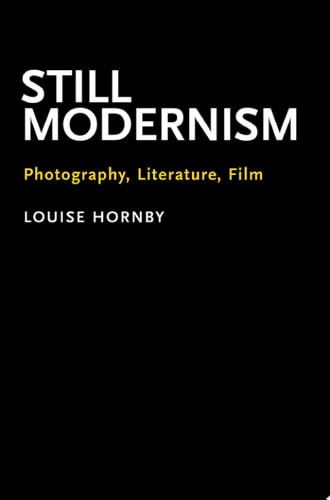
Still Modernism: Photography, Literature, Film
0
0
As an Amazon Associate and affiliate partner, Menrva Books earns from qualifying purchases. Learn more
Author Description
Still Modernism offers a critique of the modernist imperative to embrace motion, speed, and mobility. In the context of the rise of kinetic technologies and the invention of motion pictures, it claims that stillness is nonetheless an essential tactic of modernist innovation. More specifically, the book looks at the ways in which photographic stillness emerges as a counterpoint to motion and to film, asserting its own clear visibility against the blur of kinesis. Photographic stillness becomes a means to resist the ephemerality of motion and to get at and articulate something real or essential by way of its fixed limits. Combining art history, film studies and literary studies, Louise Hornby reveals how photographers, filmmakers, and writers, even at their most kinetic, did not surrender attention to points of stillness. Rather, the still image, understood through photography, establishes itself as a mode of resistance and provides a formal response to various modernist efforts to see better, to attend more closely, and to remove the fetters of subjectivity and experience.Still Modernism brings together a series of canonical texts, films, and photographs, the selection of which reinforces the central claim that stillness does not lurk at the margins of modernism, but was constitutive of its very foundations. In a series of comparisons drawing from literary and visual objects, Hornby argues that still photography allows film to access its own diffuse images of motion; photography's duplicative form provides a serial structure for modernist efforts to represent the face; its iterative structure articulates the jerky rhythms of experimental narrative as perambulation; and its processes of development allow for the world to emerge independent of the human observer. Casting new light on the relationship between photography and film, Hornby situates the struggle between the still and the kinetic at the center of modernist culture.
Menrva's Summary
THE THESIS
This book investigates the role of stillness as a foundational, rather than marginal, element of modernist innovation in the face of the era's preoccupation with speed and motion. Louise Hornby, an academic specializing in visual and literary culture, utilizes a comparative framework to analyze how photographic stillness functions as a counterpoint to kinetic technologies. By examining the intersection of photography, literature, and film, she argues that the still image serves as a formal mechanism for resisting ephemerality and articulating essential truths within modernist works.
THE SCOPE MAP
What You Will Find
- Comparative analysis of canonical modernist texts, films, and photographs.
- Theoretical exploration of the relationship between photographic seriality and narrative rhythm.
- Examination of how stillness facilitates the representation of the human face and the world independent of the observer.
Scope Limits
- The study focuses primarily on the tension between stillness and motion within the modernist period and does not provide an exhaustive history of photography or film technology.
THE AUTHORITY PERSPECTIVE
Scholars and critics recognize this work as a significant contribution to the study of modernist visual culture and intermediality. Readers frequently note the academic density of the prose, which is intended for those familiar with critical theory and modernist studies.
Page Count:
256
Publication Date:
2017-10-02
Publisher:
Oxford University Press
ISBN-10:
0190661224
ISBN-13:
9780190661229
Photography
Modernism Art
Visual Culture
Humanities
Literature
Art History
English & College Success
Modernism
Arts Modern
ART Reference
English
Motion pictures
Film Studies
In art
ART Performance
Photography
Literary Criticism
Community Tags
Similar Books