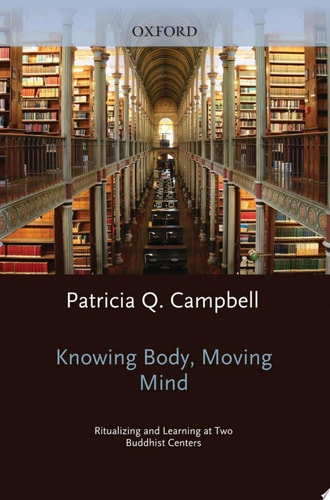
Knowing Body, Moving Mind: Ritualizing and Learning at Two Buddhist Centers
0
0
As an Amazon Associate and affiliate partner, Menrva Books earns from qualifying purchases. Learn more
Author Description
Knowing Body, Moving Mind investigates ritualizing and learning in introductory meditation classes at two Buddhist centers in Toronto, Canada. The centers, Friends of the Heart and Chandrakirti, are led and attended by Western (sometimes called 'convert') Buddhists: that is, people from non-Buddhist familial and cultural backgrounds. Inspired by theories that suggest that rituals impart new knowledge or understanding, Patricia Campbell examines how introductory meditation students learn through formal Buddhist practice. Along the way, she also explores practitioners' reasons for enrolling in meditation classes, their interests in Buddhism, and their responses to formal Buddhist practices and to ritual in general. Based on ethnographic interviews and participant-observation fieldwork, the text follows interview participants' reflections on what they learned in meditation classes and through personal practice, and what roles meditation and other ritual practices played in that learning. Participants' learning experiences are illuminated by an influential learning theory called Bloom's Taxonomy, while the rites and practices taught and performed at the centers are explored using performance theory, a method which focuses on the performative elements of ritual's postures and gestures. But the study expands the performance framework as well, by demonstrating that performative ritualizing includes the concentration techniques that take place in a meditator's mind. Such techniques are received as traditional mental acts or behaviors that are standardized, repetitively performed, and variously regarded as special, elevated, spiritual or religious. Having established a link between mental and physical forms of ritualizing, the study then demonstrates that the repetitive mental techniques of meditation practice train the mind to develop new skills in the same way that physical postures and gestures train the body. The mind is thus experienced as both embodied and gestural.
Menrva's Summary
THE THESIS
This study investigates how introductory meditation students at two Western Buddhist centers acquire new knowledge and understanding through the performance of ritualized practices. Patricia Q. Campbell, an ethnographic researcher, examines the intersection of physical ritual and mental discipline within the context of convert Buddhism in Toronto. By applying Bloom's Taxonomy to learning experiences and utilizing performance theory to analyze bodily gestures, the author argues that repetitive mental techniques function as a form of embodied training similar to physical exercise. The work posits that the mind itself is a gestural space where spiritual skills are developed through standardized, repetitive behavior.
THE SCOPE MAP
What You Will Find
- Ethnographic data gathered from participant-observation fieldwork at Friends of the Heart and Chandrakirti Buddhist centers.
- An application of Bloom's Taxonomy to evaluate the cognitive and spiritual learning processes of meditation students.
- A theoretical framework utilizing performance theory to interpret the significance of postures, gestures, and mental concentration techniques.
- Analysis of practitioner motivations, cultural backgrounds, and responses to formal religious ritual in a Western context.
THE AUTHORITY PERSPECTIVE
Experts in the sociology of religion and Buddhist studies recognize this text as a significant contribution to the understanding of Western convert Buddhism. Readers frequently note the academic density of the prose, which effectively bridges the gap between performance theory and cognitive learning models.
Page Count:
250
Publication Date:
2011-01-01
Publisher:
Oxford University Press, Incorporated
ISBN-10:
0199793948
ISBN-13:
9780199793945
Religion
Buddhism
Education
Meditation
Learning Psychology of
Anthropology
Sociology
Community Tags
Other Editions(2)
Similar Books











Reader Comments
Share Your Thoughts
No comments yet. Be the first to share your thoughts!