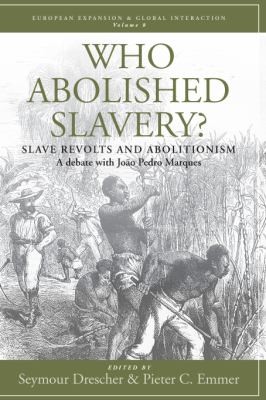
Who Abolished Slavery?
0
0
As an Amazon Associate and affiliate partner, Menrva Books earns from qualifying purchases. Learn more
Author Description
The past half-century has produced a mass of information regarding slave resistance, ranging from individual acts of disobedience to massive uprisings. Many of these acts of rebellion have been studied extensively, yet the ultimate goals of the insurgents remain open for discussion. Recently, several historians have suggested that slaves achieved their own freedom by resisting slavery, which counters the predominant argument that abolitionist pressure groups, parliamentarians, and the governmental and anti-governmental armies of the various slaveholding empires were the prime movers behind emancipation. Marques, one of the leading historians of slavery and abolition, argues that, in most cases, it is impossible to establish a direct relation between slaves' uprisings and the emancipation laws that would be approved in the western countries. Following this presentation, his arguments are taken up by a dozen of the most outstanding historians in this field. In a concluding chapter, Marques responds briefly to their comments and evaluates the degree to which they challenge or enhance his view
Menrva's Summary
THE THESIS
The question of who abolished slavery is reframed from state-led emancipation to the agency of the enslaved. João Pedro Marques, a leading historian of slavery and abolition, challenges the prevailing view that abolitionist movements and governmental actions were the primary drivers of emancipation. He argues that establishing a direct causal link between slave uprisings and subsequent emancipation laws in Western countries is often impossible. The book presents his arguments, which are then debated by other prominent historians in the field, with Marques offering a concluding response.
THE SCOPE MAP
- Analysis of slave resistance, from individual acts to large-scale revolts.
- Critique of the argument that slaves achieved freedom solely through resistance.
- Examination of the role of abolitionist pressure groups, parliamentarians, and state armies.
- Marques's central thesis on the limited direct relationship between slave uprisings and emancipation laws.
- Contributions from a dozen leading historians debating Marques's arguments.
- Marques's concluding chapter responding to commentators and evaluating their challenges.
THE AUTHORITY PERSPECTIVE
The book presents a significant scholarly debate on the mechanisms of abolition. Marques's core argument, that slave resistance did not directly cause emancipation laws in most Western countries, is a counterpoint to recent historical suggestions. The inclusion of responses from other leading historians indicates a robust engagement with his thesis. This structure allows for a multifaceted examination of the complex factors leading to the end of slavery.
Page Count:
208
Publication Date:
2010-01-01
ISBN-10:
184545636X
ISBN-13:
9781845456368
Non-Fiction
History
Abolitionism
Slavery
Social History
Community Tags
Similar Books