
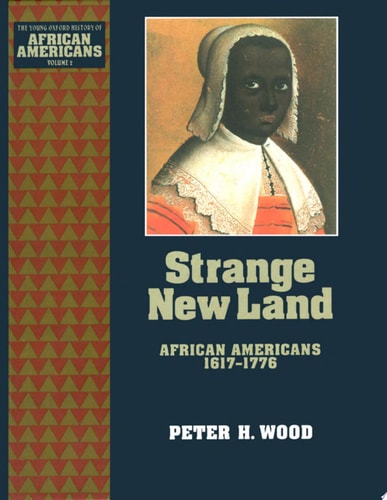
Strange New Land: African Americans 1617-1776
0
0
As an Amazon Associate and affiliate partner, Menrva Books earns from qualifying purchases. Learn more
Author Description
For Africans who survived the trans-Atlantic journey and were forced to disembark at one of the many ports along the coast of Britain's North American colonies, what lay before them was indeed a strange new land. Although forms of bondage had existed in West and Central Africa long before the trans Atlantic slave trade began, human beings were rarely the main commodity at the marketplace. Here in the modern world, the enslaved African was inspected, assessed, auctioned, bought, sold, bartered, and treated in any manner the owner saw fit. Slaves did not always cooperate. They fought and ran away, or made the business of commercial farming more difficult by not working efficiently. In spite of their condition and despite different ethnic backgrounds and languages, enslaved Africans forged a strong sense of community. The Africans learned the English language and made it their own. They learned Christianity and transformed it. Others held fast to Islam or combined their own spiritual beliefs with the faith of their masters. And all around them they heard talk of liberty and freedom, of the rights of man. Not surprisingly, many enslaved Africans embraced the idea of liberty as a fundamental right, and some even petitioned colonial administrators, insisting on that right. But the majority simply stole themselves and headed to Northern cities where slavery was less visible and where they might blend in more easily. Strange New Land explores the history of slavery and the struggle for freedom before the United States became a nation. Beginning with the colonization of North America, it documents the transformation of slavery from a brutal form of indentured servitude to a full-blown system of racial domination. More importantly, it surveys black social and cultural life, illustrating just how such a diverse group of people from the shores and hinterlands of West and Central Africa became a community in North America that survives and flourishes today.
Menrva's Summary
THE THESIS
How did enslaved Africans navigate the transition from diverse West and Central African origins to a cohesive community within the rigid, emerging system of racialized chattel slavery in colonial North America? Peter H. Wood, a historian specializing in early American history, examines the structural evolution of slavery from its inception in the early 17th century through the onset of the American Revolution. By synthesizing archival records and social history, Wood argues that enslaved individuals were not passive victims but active agents who shaped their own cultural, religious, and social identities while resisting the dehumanizing constraints of the colonial plantation economy.
THE SCOPE MAP
What You Will Find
- Analysis of the transition from indentured servitude to hereditary racial slavery.
- Examination of cultural synthesis, including the adaptation of language, Christianity, and Islam.
- Documentation of resistance strategies ranging from work slowdowns to flight and legal petitions.
Scope Limits
- The text focuses primarily on the British North American colonies and does not provide an exhaustive survey of the entire Atlantic slave trade.
- The narrative concludes at 1776, excluding the subsequent developments of the early national period.
THE AUTHORITY PERSPECTIVE
Historians and educators frequently cite this work as a foundational text for understanding the social dynamics of early African American life. Readers note that the prose is accessible to a general audience while maintaining the rigorous historical context expected of academic scholarship.
Page Count:
128
Publication Date:
1996-01-01
Publisher:
Oxford University Press
ISBN-10:
0190282207
ISBN-13:
9780190282202
History
Non-Fiction
Slavery
Minority Studies
Social History
African American
Community Tags
Other Editions(2)
Similar Books

Reader Comments
Share Your Thoughts
No comments yet. Be the first to share your thoughts!