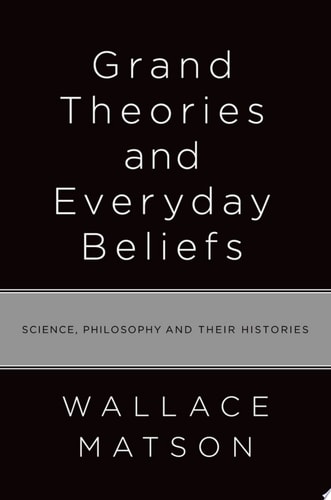
Grand Theories and Everyday Beliefs: Science, Philosophy, and Their Histories
0
0
As an Amazon Associate and affiliate partner, Menrva Books earns from qualifying purchases. Learn more
Author Description
After a Darwinian-type account of what beliefs are and how they arose in animals acting to cope with their environments--"low beliefs," virtually all of which are true--Wallace Matson here shows how the invention of language led to imagination and thence to beliefs formed in other ways ("high beliefs"), not true though thought to be, which could be consolidated into mythologies, the first Grand Unified Theories of Everything. Science began when Thales of Miletus produced a Grand Theory based on low ("everyday") beliefs. Matson traces the course of science and philosophy through seven centuries to their sudden and violent displacement by Christianity with its Grand Theory of the old type. Against the widespread opinion that modern philosophy has slowly but completely emancipated itself from bondage to theology, he shows how remnants from the medieval 'interlude' still lurk unnoticed in the purportedly neutral notions of logical possibility, possible worlds, and laws as commands, to the detriment of the natural harmony between science and philosophy, including ethics. Accessibly written, this is a book for all who are interested in the foundations of 21st century thought and who wonder where the cracks might be.
Menrva's Summary
THE THESIS
This work investigates the historical and evolutionary origins of human belief systems, questioning how the transition from survival-based cognition to abstract mythology shaped the development of science and philosophy. Wallace Matson, a noted philosopher, utilizes an evolutionary framework to distinguish between 'low beliefs'—those rooted in environmental adaptation—and 'high beliefs' born of linguistic imagination. He argues that the historical trajectory of Western thought was fundamentally disrupted by the rise of Christianity, leaving lingering theological structures that continue to distort contemporary scientific and philosophical inquiry.
THE SCOPE MAP
What You Will Find
- An evolutionary account of belief formation in animals and humans.
- A historical analysis of the transition from pre-Socratic science to medieval theology.
- A critique of modern philosophical concepts such as logical possibility and possible worlds.
- An examination of the relationship between ethics, natural philosophy, and scientific methodology.
THE AUTHORITY PERSPECTIVE
Readers frequently note the provocative nature of Matson's critique regarding the influence of medieval theology on modern analytical philosophy. Experts highlight this as a challenging, accessible text that encourages a re-evaluation of the foundational assumptions underpinning 21st-century intellectual discourse.
Page Count:
240
Publication Date:
2011-12-09
Publisher:
Oxford University Press
ISBN-10:
0199812691
ISBN-13:
9780199812691
History
Philosophy
Science
Science
Special Topics
Evolutionary Psychology
Intellectual History
Epistemology
Knowledge Theory
Community Tags
Similar Books