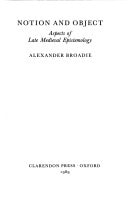
Notion and Object: Aspects of Late Medieval Epistemology
0
0
As an Amazon Associate and affiliate partner, Menrva Books earns from qualifying purchases. Learn more
Author Description
The early 16th century was a time of intense intellectual activity during which ideas central to the disputes between traditionalists and reformers were being refined. This is the first full-length study of the quest for the answer to the question then being asked: "What is knowlege?" Broadie focuses on the distinction between sensory and intellectual cognition, and on the concept of "notion" which was central to the epistemological debates of the period, paying special attention to the doctrines of John Mair, David Cranston, Gilbert Crab, George Lokert and Gervaise Waim, all philosophers at the University of Paris between 1500 and 1530 who represented the intellectual tradition confronting the reformers.
Menrva's Summary
THE THESIS
This work investigates the fundamental epistemological question of the early 16th century: what constitutes knowledge? Alexander Broadie, an expert in Scottish and medieval philosophy, examines the intellectual climate at the University of Paris between 1500 and 1530. By analyzing the doctrines of philosophers such as John Mair and George Lokert, Broadie reconstructs the framework of sensory and intellectual cognition that defined the traditionalist response to emerging reformist thought.
THE SCOPE MAP
What You Will Find
- Analysis of the distinction between sensory and intellectual cognition in late medieval thought.
- Examination of the concept of 'notion' as a central pillar of epistemological debate.
- Detailed study of the philosophical output of the University of Paris faculty between 1500 and 1530.
- Primary source exploration of the works of John Mair, David Cranston, Gilbert Crab, George Lokert, and Gervaise Waim.
THE AUTHORITY PERSPECTIVE
Scholars recognize this text as a foundational study for understanding the specific philosophical traditions that preceded the Reformation. Readers frequently note the academic density of the prose, which provides a rigorous look at scholastic debates that are often overlooked in broader historical surveys.
Page Count:
208
Publication Date:
1989-02-23
Publisher:
Oxford University Press
ISBN-10:
0198244754
ISBN-13:
9780198244752
History
Philosophy
Knowledge Theory
Epistemology
Intellectual History
Community Tags
Similar Books