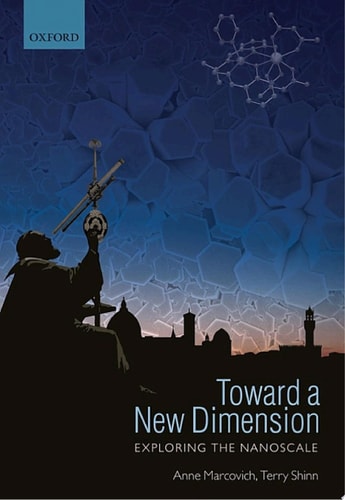
Toward a New Dimension: Exploring the Nanoscale
0
0
As an Amazon Associate and affiliate partner, Menrva Books earns from qualifying purchases. Learn more
Author Description
Over the course of the last thirty years, the investigation of objects at the nano scale has rocketed. Nanoscale scientific research has not only powerfully affected the amount and orientation of knowledge, it has perhaps even more significantly redirected the ways in which much research work is carried out, changed scientists' methodology and reasoning processes, and influenced aspects of the structure of career trajectory and the functioning of scientific disciplines. This book identifies key historical moments and episodes in the birth and evolution of nanoscience, discusses the novel repertory of epistemological concerns of practitioners, and signals sociological propensities. As Galileo's telescope explored the moon's surface four hundred years ago, nano instrumentation now makes it possible to see the surface of single molecules. Moreover, practitioners are able to manipulate individual atoms and molecules at will to produce pre-designed synthetic materials, non-existent in nature. The combinatorial of heightened observational capacity and the tailoring of synthetic artificial materials exhibiting hitherto novel physical properties has widened and transformed the worlds of scientific knowledge and technical artefact. This book invites the question: to what extent does nanoscale scientific research constitute a kind of 'scientific revolution'?
Menrva's Summary
THE THESIS
This book investigates whether the rapid emergence and development of nanoscale research constitutes a fundamental scientific revolution. The authors, Anne Marcovich and Terry Shinn, utilize historical analysis and sociological frameworks to examine how the shift toward the nanoscale has altered scientific methodology, reasoning, and the professional structure of research disciplines. By comparing modern nano-instrumentation to historical milestones like the telescope, the authors argue that the ability to manipulate individual atoms represents a significant transformation in the production of scientific knowledge.
THE SCOPE MAP
What You Will Find
- Historical analysis of the birth and evolution of nanoscience over the last thirty years
- Examination of the epistemological concerns and reasoning processes of practitioners
- Sociological assessment of career trajectories and disciplinary functioning within the field
Scope Limits
- Does not provide a technical manual for nanotechnology applications
- Does not focus on the commercial or industrial economic impact of nanotech products
THE AUTHORITY PERSPECTIVE
Experts recognize this work as a significant contribution to the sociology of science, noting its focus on the structural changes within research institutions. Readers frequently highlight the academic density of the prose, which is best suited for those interested in the philosophy and history of scientific practice.
Page Count:
229
Publication Date:
2014-01-01
Publisher:
OUP Oxford
ISBN-10:
0191024015
ISBN-13:
9780191024016
History
Science
Sociology of Science
Nanoscience
Earth Sciences
Nanotechnology
Science History
Epistemology
Community Tags
Similar Books