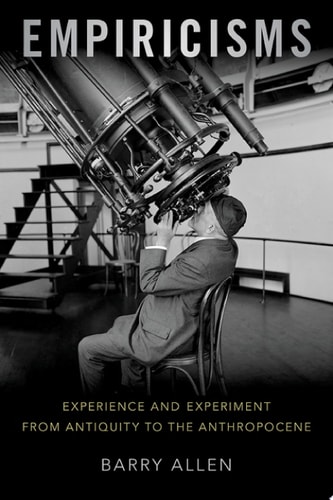
Empiricisms: Experience and Experiment from Antiquity to the Anthropocene
0
0
As an Amazon Associate and affiliate partner, Menrva Books earns from qualifying purchases. Learn more
Author Description
In this sweeping volume of comparative philosophy and intellectual history, Barry Allen reassesses the values of experience and experiment in European and world traditions. His work traces the history of empirical philosophy from its birth in Greek medicine to its emergence as a philosophy of modern science. He surveys medical empiricism, Aristotlean and Epicurean empiricism, the empiricism of Gassendi and Locke, logical empiricism, radical empiricism, transcendental empiricism, and varieties of anti-empiricism from Parmenides to Wilfrid Sellars. Throughout this extensive intellectual history, Allen builds an argument in three parts. A richly detailed account of history's empiricisms in Part One establishes a context in Part Two for reconsidering the work of the radical empiricists--William James, Henri Bergson, John Dewey, and Gilles Deleuze, each treated in a dedicated chapter. What is "radical" about them is their effort to return empiricism from epistemology to the ontology and natural philosophy where it began.In Part Three, Allen sets empirical philosophy in conversation with Chinese tradition, considering technological, scientific, medical, and alchemical sources, as well as selected Confucian, Daoist, and Mohist classics. The work shows how philosophical reflection on experience and a profound experimental practice coexist in traditional China with no interaction or even awareness of each other, slipping over each other instead of intertwining as they did in European history, a difference Allen attributes to a different understanding of the value of knowledge. Allen's book recovers empiricism's neglected, multi-textured contexts, and elucidates the enduring value of experience, to arrive at an idea of what is living and dead in philosophical empiricism.
Menrva's Summary
THE THESIS
This volume investigates the historical evolution and philosophical significance of empiricism by tracing its development from ancient medical practices to its modern scientific applications. Barry Allen, a scholar of philosophy, utilizes a comparative historical framework to analyze how different cultures have valued experience and experiment. He argues that while European traditions integrated empirical philosophy with scientific practice, other traditions, such as those in China, maintained distinct paths for experimental practice and philosophical reflection. The work ultimately seeks to distinguish the enduring components of empirical thought from those that have lost their relevance in contemporary discourse.
THE SCOPE MAP
What You Will Find
- A comprehensive historical survey of empirical thought ranging from Greek medicine to the Anthropocene.
- Comparative analysis of European philosophical traditions alongside Chinese technological, medical, and alchemical sources.
- Dedicated examinations of radical empiricists including William James, Henri Bergson, John Dewey, and Gilles Deleuze.
- A critical evaluation of the intersection between epistemology, ontology, and natural philosophy.
THE AUTHORITY PERSPECTIVE
Experts recognize this work as a significant contribution to comparative intellectual history due to its expansive scope and rigorous cross-cultural analysis. Readers often note the academic density of the prose, which requires a foundational understanding of philosophical terminology to fully engage with the author's arguments.
Page Count:
539
Publication Date:
2020-01-01
Publisher:
Oxford University Press
ISBN-10:
0197508952
ISBN-13:
9780197508954
Philosophy
History
Science
History & Surveys
Comparative Philosophy
Empiricism
Intellectual History
Epistemology
Earth Sciences
Community Tags
Other Editions(2)

Similar Books



Reader Comments
Share Your Thoughts
No comments yet. Be the first to share your thoughts!