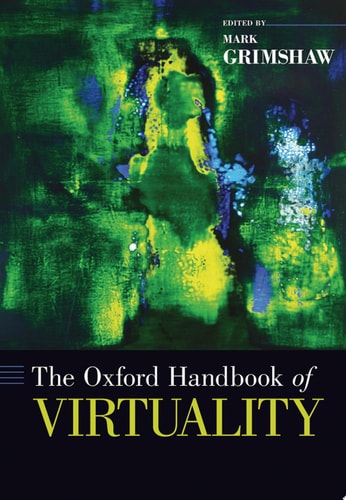
The Oxford Handbook of Virtuality
0
0
As an Amazon Associate and affiliate partner, Menrva Books earns from qualifying purchases. Learn more
Author Description
As this comprehensive and multidisciplinary book makes clear, virtuality has a pedigree that pre-dates the computer age and modern virtual worlds, a pedigree that can be traced back to classical mythology and beyond. Equally, the concept of virtuality is not the province of one field of study alone but is the foundation and driving force of many, both theoretical and applied.Our conceptualizations and applications of virtuality are multiple, as contributors demonstrate across the nine sections of the book that move from philosophy to technologies and applications before returning to philosophy again for a discussion of the utopias and dystopias of virtuality. The almost 50 essays contained within range freely across subjects that include the potential of virtuality, ethics, virtuality and self, presence and immersion, virtual emotions, image, sound and literature, computer games, AI and A-Life, Augmented Reality and Real Virtuality, law and economics, medical and military applications, religion, and cybersex.Throughout, contributors discuss differences between virtuality, reality, and actuality, in debates filtered through the lenses of the disciplines represented here, and speculate on future directions. It is not at all clear that there are differences and, if such distinctions are to be found, the boundaries between virtuality, reality, and actuality continually shift as ideas, modes of organization, and behaviors constantly flow from one to the other regardless of direction. The Handbook presents no unified definition of virtuality to comfort the reader, rather a multiplicity of questions and approaches underpinned by provocative statements that should further fuel the debates surrounding our notions of virtuality.
Menrva's Summary
THE THESIS
This volume investigates the multifaceted nature of virtuality, questioning whether distinct boundaries exist between virtual, real, and actual experiences. Editor Mark Grimshaw compiles nearly 50 essays from a multidisciplinary group of scholars to examine how virtuality functions as a foundational concept across philosophy, technology, and applied sciences. The text argues that virtuality is not a modern invention but a historical phenomenon that continues to shape human behavior, ethics, and societal structures.
THE SCOPE MAP
What You Will Find
- Historical and philosophical foundations of virtuality dating back to classical mythology.
- Analysis of virtuality in diverse fields including law, economics, medicine, and military applications.
- Exploration of technical domains such as Augmented Reality, Artificial Intelligence, and computer gaming.
- Examination of the psychological and social dimensions of presence, immersion, and virtual emotions.
THE AUTHORITY PERSPECTIVE
Experts recognize this handbook as a comprehensive, high-level reference work that successfully bridges the gap between theoretical philosophy and practical technological application. Readers frequently note the academic density of the prose, which serves as a foundational resource for researchers navigating the complex intersections of digital and physical realities.
Page Count:
792
Publication Date:
2013-01-01
Publisher:
Oxford University Press
ISBN-10:
0199826242
ISBN-13:
9780199826247
Philosophy
Humanities
Special Topics
Technology
Sociology
Customs & Traditions
Professional Career & Trade
Reference
Communication
Computer Science
Community Tags
Other Editions(3)
Similar Books









Reader Comments
Share Your Thoughts
No comments yet. Be the first to share your thoughts!