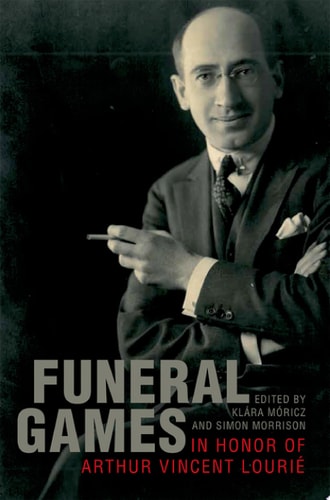
Funeral Games in Honor of Arthur Vincent Lourié
0
0
As an Amazon Associate and affiliate partner, Menrva Books earns from qualifying purchases. Learn more
Author Description
Funeral Games in Honor of Arthur Vincent Lourié explores the varied aesthetic impulses and ever-evolving personal motivations of Russian composer Arthur Lourié. A St. Petersburg native allied with the Futurist movement and profoundly sympathetic to Silver Age decadence, Lourié was swept away by the Revolution; he surfaced as a Communist commissar of music before landing in Europe and America, where his career foundered. Making his way by serving others, he became Stravinsky's right-hand man, Serge Koussevitsky's ghostwriter, and philosopher Jacques Maritain's muse. Lourié left his mark on the poems of Anna Akhmatova, on the neoclassical aesthetics of Stravinsky, on Eurasianism, and on Maritain's NeoThomist musings about music.Lourié serves as a flawless lens through which aspects of Silver Age Russia, early Bolshevik rule, and the cultural space of exile come into sharper focus. But this interdisciplinary collection of essays, edited by musicologists Klára Móricz and Simon Morrison, also looks at Lourié himself as an artist and intellectual in his own right. Much of the aesthetic and technical discussion concerns his grandly eulogistic opera The Blackamoor of Peter the Great, understood as both a belated Symbolist work and as a NeoThomist exercise. Despite the importance Lourié attached to the opera as his masterwork, Blackamoor has never been performed, its fate thus serving as an emblem of Lourié's own. Yet even if Lourié seems to have been destined to be but a footnote in the pages of music history, he looms large in studies of emigration and cultural memory. Here Lourié's life, like his last opera, is presented as a meditation on the circumstances and psychology of exile. Ultimately, these essays recover a lost realm of musical and aesthetic possibilities-a Russia that Lourié, and the world, saw disappear.
Menrva's Summary
THE THESIS
This collection of essays investigates the complex life and aesthetic contributions of Russian composer Arthur Vincent Lourié, questioning how his role as a peripheral figure in the lives of major intellectuals reflects the broader experience of exile. Editors Klára Móricz and Simon Morrison compile interdisciplinary research to analyze Lourié’s transition from a Futurist in St. Petersburg to a collaborator in the West. The text utilizes his unfinished opera, The Blackamoor of Peter the Great, as a central framework to examine his NeoThomist philosophy and Symbolist influences. By situating Lourié within the cultural space of the early twentieth century, the authors argue that his career serves as a vital lens for understanding the psychological and political dimensions of the Russian diaspora.
THE SCOPE MAP
What You Will Find
- Historical analysis of the Russian Silver Age and the impact of early Bolshevik rule on the arts.
- Technical examination of Lourié’s neoclassical aesthetics and his influence on Igor Stravinsky and Jacques Maritain.
- Case studies focusing on the opera The Blackamoor of Peter the Great as a symbol of unfulfilled artistic potential.
- Exploration of the intersection between musicology, philosophy, and the sociology of emigration.
THE AUTHORITY PERSPECTIVE
Scholars and musicologists view this work as a significant recovery project that elevates a previously overlooked figure in twentieth-century music history. Readers frequently note the academic density of the prose, which provides a rigorous examination of both the composer's technical output and his broader cultural significance.
Page Count:
320
Publication Date:
2014-06-09
Publisher:
Oxford University Press
ISBN-10:
0199829446
ISBN-13:
9780199829446
Music
History
Biography
Composers
Essays
Community Tags
Other Editions(2)

Similar Books


Reader Comments
Share Your Thoughts
No comments yet. Be the first to share your thoughts!