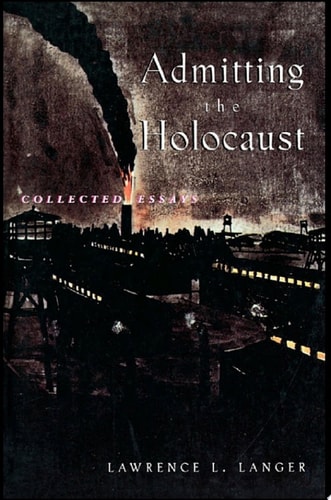
Admitting the Holocaust: Collected Essays
0
0
As an Amazon Associate and affiliate partner, Menrva Books earns from qualifying purchases. Learn more
Author Description
In the face of the Holocaust, writes Lawrence L. Langer, our age clings to the stable relics of faded eras, as if ideas like natural innocence, innate dignity, the inviolable spirit, and the triumph of art over reality were immured in some kind of immortal shrine, immune to the ravages of history and time. But these ideas have been ravaged, and in Admitting the Holocaust. Langer presents a series of essays that represent his effort, over nearly a decade, to wrestle with this rupture in human values--and to see the Holocaust as it really was. His vision is necessarily dark, but he does not see the Holocaust as a warrant for futility, or as a witness to the death of hope. It is a summons to reconsider our values and rethink what it means to be a human being. These penetrating and often gripping essays cover a wide range of issues, from the Holocaust's relation to time and memory, to its portrayal in literature, to its use and abuse by culture, to its role in reshaping our sense of history's legacy. In many, Langer examines the ways in which accounts of the Holocaust--in history, literature, film, and theology--have extended, and sometimes limited, our insight into an event that is often said to defy understanding itself. He singles out Cynthia Ozick as one of the few American writers who can meet the challenge of imagining mass murder without flinching and who can distinguish between myth and truth. On the other hand, he finds Bernard Malamud's literary treatment of the Holocaust never entirely successful (it seems to have been a threat to Malamud's vision of man's basic dignity) and he argues that William Styron's portrayal of the commandant of Auschwitz in Sophie's Choice pushed Nazi violence to the periphery of the novel, where it disturbed neither the author nor his readers. He is especially acute in his discussion of the language used to describe the Holocaust, arguing that much of it is used to console rather than to confront. He notes that when we speak of the
Menrva's Summary
THE THESIS
How can humanity reconcile the reality of the Holocaust with traditional concepts of dignity, innocence, and the human spirit? Lawrence L. Langer, a scholar of Holocaust literature, argues that conventional cultural frameworks often obscure the true nature of the genocide by attempting to impose comfort or false hope onto an event that defies such narratives. Through a series of essays, he challenges readers to confront the rupture in human values caused by the Holocaust without resorting to sentimental or reductive interpretations.
THE SCOPE MAP
What You Will Find
- Analysis of Holocaust representation in literature, film, and theology.
- Critical examinations of works by authors such as Cynthia Ozick, Bernard Malamud, and William Styron.
- Investigations into the role of language, memory, and time in shaping historical understanding.
Scope Limits
- The text does not provide a comprehensive chronological history of the Holocaust.
- It does not offer a sociological study of the perpetrators or victims beyond their representation in cultural media.
THE AUTHORITY PERSPECTIVE
Scholars and critics frequently cite this collection as a rigorous, uncompromising examination of how cultural narratives often sanitize historical trauma. Readers often note the intellectual density of the prose, which demands a high level of engagement with the philosophical and literary questions posed by the author.
Page Count:
199
Publication Date:
1996-01-01
Publisher:
Oxford University Press
ISBN-10:
0190283041
ISBN-13:
9780190283049
Philosophy
History
Essays
Modern History
Jewish History
Literary Criticism
Community Tags
Similar Books