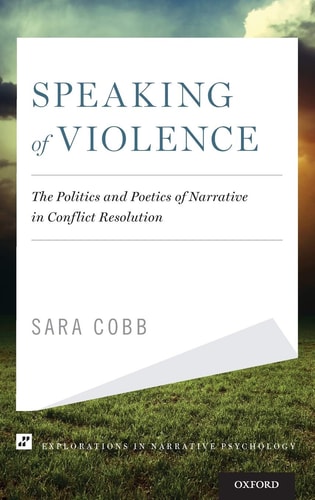
Speaking of Violence: The Politics and Poetics of Narrative in Conflict Resolution
0
0
As an Amazon Associate and affiliate partner, Menrva Books earns from qualifying purchases. Learn more
Author Description
In the context of ongoing or historical violence, people tell stories about what happened, who did what to whom and why. Yet frequently, the speaking of violence reproduces the social fractures and delegitimizes, again, those that struggle against their own marginalization. This speaking of violence deepens conflict and all too often perpetuates cycles of violence. Alternatively, sometimes people do not speak of the violence and it is erased, buried with the bodies that bear it witness. This reduces the capacity of the public to address issues emerging in the aftermath of violence and repression.This book takes the notion of "narrative" as foundational to conflict analysis and resolution. Distinct from conflict theories that rely on accounts of attitudes or perceptions in the heads of individuals, this narrative perspective presumes that meaning, structured and organized as narrative processes, is the location for both analysis of conflict, as well as intervention.But meaning is political, in that not all stories can be told, or the way they are told delegitimizes and erases others. Thus, the critical narrative theory outlined in this book offers a normative approach to narrative assessment and intervention. It provides a way of evaluating narrative and designing "better-formed" stories: "better" in that they are generative of sustainable relations, creating legitimacy for all parties. In so doing, they function aesthetically and ethically to support the emergence of new histories and new futures. Indeed, critical narrative theory offers a new lens for enabling people to speak of violence in ways that undermine the intractability of conflict
Menrva's Summary
THE THESIS
This book investigates how the act of narrating violence can either perpetuate social fractures or serve as a mechanism for conflict resolution. Sara Cobb, a scholar in narrative psychology, argues that traditional conflict theories often overlook the structural power of storytelling. By shifting the focus from individual perceptions to the narrative processes themselves, the author presents a critical framework for analyzing how stories are constructed, silenced, or legitimized in post-conflict environments.
THE SCOPE MAP
What You Will Find
- A critical narrative theory framework for assessing conflict-related discourse.
- Methodologies for identifying how storytelling delegitimizes marginalized voices.
- Normative approaches to designing better-formed, generative narratives.
- Analysis of the intersection between aesthetics, ethics, and political power in communication.
THE AUTHORITY PERSPECTIVE
Experts in conflict resolution and psychology recognize this work as a significant contribution to the study of narrative discourse in intractable conflicts. Scholars frequently cite the text for its rigorous application of narrative theory to practical intervention strategies.
Page Count:
320
Publication Date:
2013-06-20
Publisher:
Oxford University Press
ISBN-10:
019982620X
ISBN-13:
9780199826209
Psychology
Conflict Resolution
Discourse Analysis
Communication Studies
Sociology
Violence
Community Tags
Similar Books