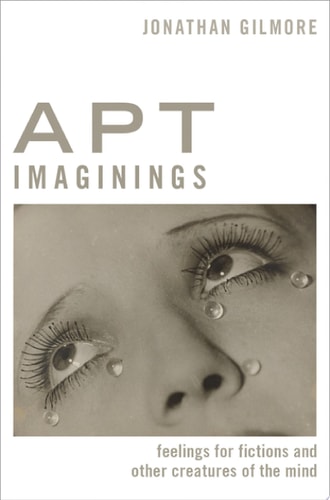
Apt Imaginings: Feelings for Fictions and Other Creatures of the Mind
0
0
As an Amazon Associate and affiliate partner, Menrva Books earns from qualifying purchases. Learn more
Author Description
How do our engagements with fictions and other products of the imagination compare to our experiences of the real world? Are the feelings we have about a novel's characters modelled on our thoughts about actual people? If it is wrong to feel pleasure over certain situations in real life, can it nonetheless be right to take pleasure in analogous scenarios represented in a fantasy or film? Should the desires we have for what goes on in a make-believe story cohere with what we want to happen in the actual world? Such queries have animated philosophical and psychological theorizing about art and life from Plato's Republic and Aristotle's Poetics to contemporary debates over freedom of expression, ethics and aesthetics, the cognitive value of thought experiments, and the effects on audiences of exposure to violent entertainment.In Apt Imaginings, Jonathan Gilmore develops a new framework to pursue these questions, marshalling a wide range of research in aesthetics, the science of the emotions, moral philosophy, neuroscience, cognitive psychology, and film and literary theory. Gilmore argues that, while there is a substantial empirical continuity in our feelings across art and life, the norms that govern the appropriateness of those responses across the divide are discontinuous. In this view, the evaluative criteria that determine the fit, correctness, or rationality of our emotions and desires for what is internal to a fiction can be contrary to those that govern our affective attitudes toward analogous things in the real world. In short, it can be right to embrace within a story what one would condemn in real life. The theory Gilmore defends in this volume helps to explain our complex and sometimes conflicted attitudes toward works of the imagination; challenges the popular view that fictions serve to refine our moral sensibilities; and exposes a kind of autonomy of the imagination that can render our responses to art immune to standard real-world epistemic, practical, and affective kinds of criticism.
Menrva's Summary
THE THESIS
How do the norms governing our emotional responses to fictional scenarios differ from those that regulate our reactions to real-world events? Jonathan Gilmore, a scholar of philosophy and aesthetics, investigates the intersection of cognitive science, moral philosophy, and literary theory to propose a framework for understanding the autonomy of the imagination. He argues that the evaluative criteria for our affective responses to art are distinct from, and sometimes contrary to, the moral standards applied to reality.
THE SCOPE MAP
What You Will Find
- A comparative analysis of emotional responses to real versus fictional entities.
- A synthesis of research from neuroscience, cognitive psychology, and moral philosophy.
- An examination of the historical philosophical discourse ranging from Plato and Aristotle to contemporary media studies.
Scope Limits
- The text does not provide a comprehensive history of art criticism.
- It does not offer a prescriptive guide for moral behavior in daily life.
THE AUTHORITY PERSPECTIVE
Scholars and critics recognize this work as a significant contribution to the philosophy of art, particularly for its interdisciplinary approach to the cognitive science of emotion. Readers frequently note the academic density of the prose, which is intended for those familiar with contemporary debates in aesthetics and moral psychology.
Page Count:
270
Publication Date:
2020-01-01
Publisher:
Oxford University Press
ISBN-10:
0190096365
ISBN-13:
9780190096366
Philosophy
Cognitive Psychology
Neuroscience
Mind & Body
Ethics
Knowledge Theory
Aesthetics
Literary theory
Community Tags
Other Editions(2)

Similar Books

Reader Comments
Share Your Thoughts
No comments yet. Be the first to share your thoughts!