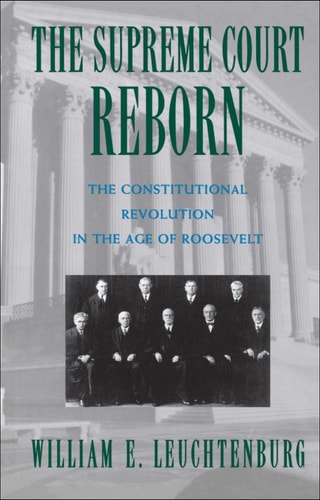
The Supreme Court Reborn: The Constitutional Revolution in the Age of Roosevelt
0
0
As an Amazon Associate and affiliate partner, Menrva Books earns from qualifying purchases. Learn more
Author Description
For almost sixty years, the results of the New Deal have been an accepted part of political life. Social Security, to take one example, is now seen as every American's birthright. But to validate this revolutionary legislation, Franklin Roosevelt had to fight a ferocious battle against the opposition of the Supreme Court--which was entrenched in laissez faire orthodoxy. After many lost battles, Roosevelt won his war with the Court, launching a Constitutional revolution that went far beyond anything he envisioned. In The Supreme Court Reborn, esteemed scholar William E. Leuchtenburg explores the critical episodes of the legal revolution that created the Court we know today. Leuchtenburg deftly protrays the events leading up to Roosevelt's showdown with the Supreme Court. Committed to laissez faire doctrine, the conservative "Four Horsemen"--Justices Butler, Van Devanter, Sutherland, and McReynolds, aided by the swing vote of Justice Owen Roberts--struck down one regulatory law after another, outraging Roosevelt and much of the Depression-stricken nation. Leuchtenburg demonstrates that Roosevelt thought he had the backing of the country as he prepared a scheme to undermine the Four Hoursemen. Famous (or infamous) as the "Court-packing plan," this proposal would have allowed the president to add one new justice for every sitting justice over the age of seventy. The plan picked up considerable momentum in Congress; it was only after a change in the voting of Justice Roberts (called "the switch in time that saved nine") and the death of Senate Majority Leader Joseph T. Robinson that it shuddered to a halt. Rosevelt's persistence led to one of his biggest legislative defeats. Despite the failure of the Court-packing plan, however, the president won his battle with the Supreme Court; one by one, the Four Horsemen left the bench, to be replaced by Roosevelt appointees. Leuchtenburg explores the far-reaching nature of FDR's victory. As a consequence of the Constitutional Rev
Menrva's Summary
THE THESIS
The book investigates the constitutional crisis of the 1930s, specifically questioning how Franklin D. Roosevelt's conflict with the Supreme Court fundamentally altered the American legal landscape. William E. Leuchtenburg, a distinguished historian of the New Deal era, utilizes primary source documents, legislative records, and judicial archives to construct his analysis. He argues that while Roosevelt's specific 'Court-packing' plan failed, the political pressure exerted by the administration successfully forced a shift in judicial philosophy that permanently expanded federal regulatory power. The text examines the transition from laissez-faire constitutionalism to the modern administrative state.
THE SCOPE MAP
What You Will Find
- Detailed analysis of the 'Four Horsemen' and their judicial impact on New Deal legislation.
- Examination of the political maneuvering behind the Judicial Procedures Reform Bill of 1937.
- Historical context regarding the 'switch in time that saved nine' and its impact on the Supreme Court's legitimacy.
- Evaluation of the long-term consequences of Roosevelt's judicial appointments on American constitutional interpretation.
THE AUTHORITY PERSPECTIVE
Scholars and legal historians frequently cite this work as a definitive account of the 1937 constitutional crisis. Readers often note the academic rigor and the detailed narrative style that makes complex legal history accessible to a broader audience.
Page Count:
364
Publication Date:
1996-01-01
Publisher:
Oxford University Press
ISBN-10:
0199839387
ISBN-13:
9780199839384
Biography
Politics
History
Law
American History
United States
Professional Career & Trade
Constitutional Law
Community Tags
Similar Books