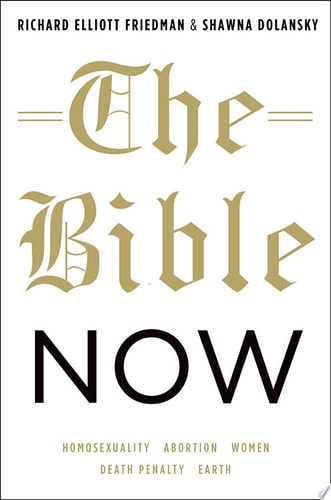
The Bible Now
0
0
As an Amazon Associate and affiliate partner, Menrva Books earns from qualifying purchases. Learn more
Author Description
For millennia, people have used the Bible as a touchstone on important social and political questions, and rightly so. But many use the Bible simply as a weapon to wield against opponents in a variety of debates--without knowing what the Bible actually says about the issue in question. In The Bible Now, two respected biblical scholars, Richard Elliott Friedman and Shawna Dolansky, tell us carefully what the Hebrew Bible says or does not say about a wide range of issues--including homosexuality, abortion, women's status, capital punishment, and the environment. In fascinating passages that shed new light on some of today's most passionate disputes, the authors reveal how the Bible is frequently misunderstood, misquoted, mistranslated, and misused. For instance, those who quote the Bible in condemning homosexuality often cite the story of Sodom, and those who favor homosexuality point to David's lament over the death of Jonathan. But as the authors show, neither passage is clearly about homosexuality, and these texts do not offer solid footing on which to make an argument. Readers learn that female homosexuality is not prohibited--only male homosexuality. And on the subject of abortion, the Bible is practically silent, with one extraordinary exception. The Bible has inspired people to do great good but has also been used by people to do great harm, so it is vitally important for us to pay attention to it--and to get it right. The Bible Now shows us how we can--and cannot--use this ancient source of wisdom to address our most current and pressing issues.
Menrva's Summary
THE THESIS
This book investigates how the Hebrew Bible is frequently misunderstood, misquoted, and weaponized in contemporary social and political debates. Authors Richard Elliott Friedman and Shawna Dolansky, both established biblical scholars, utilize historical-critical analysis to examine what the text actually states regarding modern controversies. By stripping away centuries of interpretive bias, they provide a framework for understanding the original context of biblical passages versus their modern application. The authors argue that a precise reading of the text is necessary to determine whether the Bible can legitimately inform current moral discourse.
THE SCOPE MAP
What You Will Find
- Analysis of biblical texts concerning homosexuality, abortion, and capital punishment.
- Examination of the historical status of women within ancient Israelite society.
- Evaluation of biblical perspectives on environmental stewardship and human responsibility.
- Methodological critique of how ancient texts are translated and applied to modern political agendas.
THE AUTHORITY PERSPECTIVE
Scholars and readers alike recognize this work as a balanced, accessible entry point for those seeking to understand the intersection of ancient scripture and modern ethics. Experts highlight the authors' ability to distill complex philological and historical data into clear arguments that challenge common misconceptions held by both religious and secular audiences.
Page Count:
239
Publication Date:
2011-01-01
Publisher:
Oxford University Press
ISBN-10:
0199831572
ISBN-13:
9780199831579
History
Religion
Social Issues
Ethics
The Bible
Bibles
Community Tags
Other Editions(3)
Similar Books
Reader Comments
Share Your Thoughts
No comments yet. Be the first to share your thoughts!