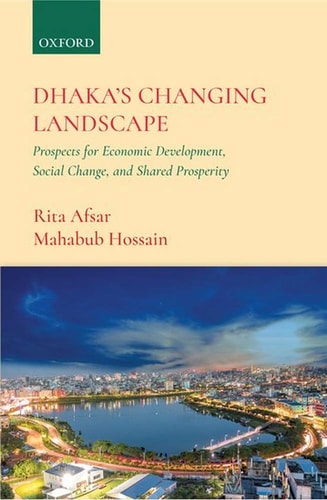
Dhaka's Changing Landscape: Prospects for Economic Development, Social Change, and Shared Prosperity
0
0
As an Amazon Associate and affiliate partner, Menrva Books earns from qualifying purchases. Learn more
Author Description
The book is about residents of Dhaka: migrant and non-migrant, poor and non-poor, men and women, young and old. It is about how they have experienced the city's rapid transition for the two decades between 1991 and 2010 in terms of quality of life and livelihoods, and their prospects for a shared future. It is not so common to come across urban studies based on longitudinal data largely due to the high mobility of urban households. Over the 20-year period, the city's population more than doubled and reached double digit figures at 15 million. At the same time, its contribution to the national economy almost trebled from 13 per cent to 36 per cent. An unmistakable trend of economic growth is evidenced along with the rapid decline of urban poverty and a downward trend in inequality in the country during the same reference period. At the other end of the spectrum are the environmental challenges in the context of high density and Dhaka's worst livability ranking. The book answers some of the doubts generated by these contradictory signals of rapid urbanization: is the poorer segment of urban population that migrates with dreams for better lives and livelihoods benefitting from positive economic trends? Are these benefits sustainable in the long run? Have these benefits brought qualitative changes creating scope for this group to have a stake in the city's growing prosperity like their non-poor counterparts?
Menrva's Summary
THE THESIS
This book investigates whether the rapid economic growth and urbanization of Dhaka between 1991 and 2010 have translated into tangible improvements in quality of life and shared prosperity for the city's diverse socioeconomic populations. The authors, Mahabub Hossain and Rita Afsar, utilize longitudinal data to track the experiences of migrant and non-migrant households across various income levels and demographics. Their framework contrasts macroeconomic indicators of growth and poverty reduction against the persistent challenges of high population density and environmental degradation. By analyzing these contradictory signals, the authors assess the sustainability of urban development and the extent to which the poor have secured a stake in the city's economic expansion.
THE SCOPE MAP
What You Will Find
- Longitudinal analysis of household livelihoods in Dhaka from 1991 to 2010.
- Comparative data on poverty reduction and inequality trends within an urban context.
- Examination of the relationship between rapid population growth and national economic contribution.
- Qualitative assessment of social mobility and living standards among diverse urban groups.
Scope Limits
- The analysis is bounded by the 1991-2010 timeframe and does not cover subsequent urban developments.
- The study focuses specifically on Dhaka and may not be generalizable to other urban centers in the region.
THE AUTHORITY PERSPECTIVE
Experts recognize this work as a significant contribution to urban studies due to its rare reliance on longitudinal household data in a highly mobile urban environment. Scholars often cite the text for its balanced approach in addressing both the economic gains and the environmental constraints of rapid urbanization in South Asia.
Page Count:
328
Publication Date:
2020-03-28
Publisher:
Oxford University Press
ISBN-10:
0190121114
ISBN-13:
9780190121112
Economics
Sociology
Bangladesh
Urbanization
Urban Studies
Community Tags
Similar Books