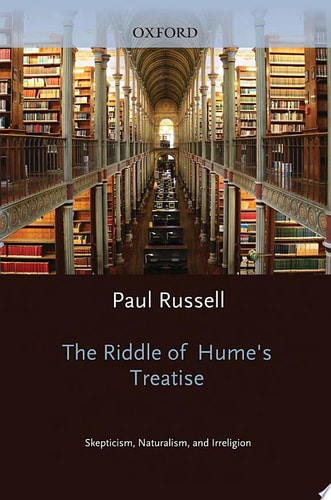
The Riddle of Hume's Treatise: Skepticism, Naturalism, and Irreligion
0
0
As an Amazon Associate and affiliate partner, Menrva Books earns from qualifying purchases. Learn more
Author Description
Although it is widely recognized that David Hume's A Treatise of Human Nature (1729-40) belongs among the greatest works of philosophy, there is little aggreement about the correct way to interpret his fundamental intentions.The solution to this riddle depends on challenging another, closely related, point of orthodoxy: namely, that before Hume published the Treatise he removed almost all material concerned with problems of religion. Russell argues, contrary to this view, that irreligious aims and objectives are fundamental to the Treatise and account for its underlying unity and coherence. It is Hume's basic anti-Christian aims and objectives that serve to shape and direct both his skeptical and naturalistic commitments. When Hume's arguments are viewed from this perspective we can solve, not only puzzles arising from his discussion of various specific issues, we can also explain the intimate and intricate connections that hold his entire project together.This "irreligious" interpretation provides a comprehensive fresh account of the nature of Hume's fundamental aims and ambitions in the Treatise. It also presents a radically different picture of the way in which Hume's project was rooted in the debates and controversies of his own time, placing the Treatise in an irreligious or anti-Christian philosophical tradition that includes Hobbes, Spinoza and freethinking followers. Considered in these terms, Hume's Treatise constitutes the crowning achievement of the Radical Enlightenment.
Menrva's Summary
THE THESIS
This book investigates the core question of whether David Hume’s A Treatise of Human Nature was fundamentally shaped by an anti-Christian agenda rather than being a purely secular philosophical inquiry. Paul Russell, a scholar of Hume and the Enlightenment, challenges the long-standing academic orthodoxy that Hume excised religious concerns from his work. He argues that irreligious objectives provide the necessary unity and coherence to understand Hume’s skeptical and naturalistic commitments, positioning the Treatise as the definitive project of the Radical Enlightenment.
THE SCOPE MAP
What You Will Find
- A re-evaluation of the historical context surrounding the composition of the Treatise.
- An analysis of the intellectual lineage connecting Hume to Hobbes, Spinoza, and other freethinking philosophers.
- A systematic examination of how anti-Christian aims influence Hume’s specific arguments on skepticism and naturalism.
- A comprehensive framework for interpreting the underlying unity of Hume’s philosophical project.
THE AUTHORITY PERSPECTIVE
Scholars frequently cite this work as a significant challenge to traditional interpretations of Hume’s intentions. Experts highlight the text as a rigorous contribution to the study of the Radical Enlightenment and the history of secular philosophy.
Page Count:
442
Publication Date:
2008-01-01
Publisher:
Oxford University Press
ISBN-10:
019988045X
ISBN-13:
9780199880454
Philosophy
Politics
Religion
Kindle eBooks
Atheism
Movements
Linguistics
Enlightenment
History & Surveys
Skepticism
Reference
Categories
Words Language & Grammar
Kindle Store
Community Tags
Similar Books